Thursday, 22 September 2016


ON THIS DAY IN HORROR - September 22nd
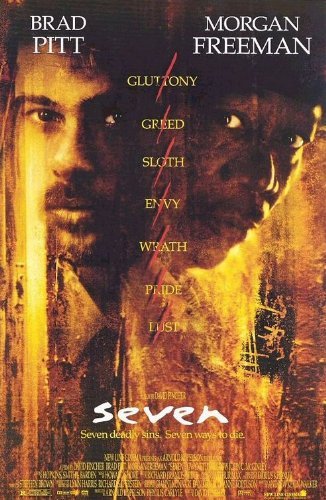
"SE7EN" released in 1995


There are seven deadly sins - Gluttony, Greed, Sloth, Lust, Wraith, Pride, and Envy - and somewhere in an unnamed, rain drenched city, a serial killer is using each sin to punish the sinners, with a jaded veteran and an eager rookie detective hot on his trail, in David Fincher's neo-noir psychological thriller Se7en!


Watch the Se7en trailer below!


Don't miss out on future blogs, trailers, and clips IHdb has coming up 
by Following IHdb's Facebook page above!


Soon-to-be-retiring detective William Somerset (Morgan Freeman) is partnered with short-tempered but idealistic David Mills (Brad Pitt), who recently transferred to the department, moving to the city with his wife Tracy (Gwyneth Paltrow). Their first case together involves the brutal murder of an obese man who, according to the autopsy later, was forced to eat until his stomach ruptured. It isn't until Mills investigates a second victim - a high profile defense attorney Eli Gould (Gene Borkan), who died from bloodletting after removing a pound of his own flesh - that they discover a single word, "Greed", written in the victims blood on the carpet. Using this one clue, Somerset finds a similar word, "Gluttony", hidden behind the obese victims refrigerator, and is able to deduce that the killer is recreating the Seven Deadly Sins as written in Dante's epic poem The Divine Comedy. Now recognizing that the victims are related, Somerset warns that there will be five more victims. Acting on a clue given by Mrs Gould (Julie Araskog), Somerset and Mills discover a message written in fingerprints - Help Me - that belonged to a known drug dealer and child molester. But rather than being the perpetrator, he is actually the third victim (Sloth), with photos indicating the killer has had him strapped to his own bed for a year, proving the killer has been planning these deaths for some time. Using somewhat "unethical" means, Somerset contacts a source he has in the FBI and is provided with a computer printout of individuals who have checked out various books concerning the seven deadly sins and other works from the public library. They quickly identify a man on the list, known simply as John Doe (Kevin Spacey), and confront him at his apartment building. A gun fight and foot chase quickly ensues, and Mills is wounded by Doe. Returning to Doe's apartment, they find hundreds of handwritten journals showing Doe's apparent psychopathy, and clues leading to a fourth victim. But they arrive too late to prevent the death of the next two victims (Lust and Pride); a prostitute killed by an unwilling man forced by Doe to wear a bladed S&M phallic device on his genitals and to rape and kill her while severely traumatizing him, and an attractive young woman, presumably a model, whose face has been mutilated by Doe and who chose suicide rather than to live disfigured. As Somerset and Mills return to the police station, they are approached by Doe covered in blood, surrendering himself. But just as the Police Captain (R. Lee Ermey) and the District Attorney Martin Talbot (Richard Roundtree) think the case is over, Doe still has the upper hand and devises a plan to complete his work, involving Somerset and Mills in a deadly confrontation.


[turning to Somerset]
David Mills: Honestly, have you ever seen anything like this?
William Somerset: No.
Top:   Det. Somerset (Morgan Freeman) explains the seven deadly sins the killer is using as tropes in his murders;
Above:   Somerset and rookie Det. Mills (Brad Pitt) investigate the "Pride" murder scene


The primary influence for the film's screenplay came from Andrew Kevin Walker's time spent in New York City, while trying to make it as a screenwriter. Walker wrote the script over a two year period while working at a branch of Tower Records, later stated, "I didn't like my time in New York, but it's true that if I hadn't lived there I probably wouldn't have written Seven." Walker had enormous difficulty getting a studio to buy the rights to his script because he was a complete unknown in Hollywood. Allegedly, he put together a list of agents that represented writers that work in the crime and thriller genres, and just called each one up until he got a positive response and the script was picked up by New Line Cinema. Immediately, the studio wanted this film to be it's first A-List production - attaching known stars and an experienced director - but had difficulty in the beginning of development attracting talent. David Cronenberg and Guillermo del Toro turned down the chance to direct (del Toro stated as a romantic, he didn't "subscribe to the script's dark view of the world.") and both Al Pacino and Denzel Washington - early choices for Somerset and Mills - both declined as well; Pacino declined, as he was already scheduled to film City Hall (1996), and Washington turned down the offer, deeming the film to be "too dark." Both actors however later expressed regret in not taking their individual offers. 

At the time, David Fincher had not read a script for a year and a half since after the frustrating experience of making Alien 3 (1992) - where he constantly battled with the studio and was even fired three times - said, "I thought I'd rather die of colon cancer than do another movie". Fincher eventually agreed to direct the film because he was drawn to the script, which he found to be a "connect-the-dots movie that delivers about inhumanity. It's psychologically violent. It implies so much, not about why you did but how you did it". He found it more a "meditation on evil" rather than a "police procedural". Fincher was also determined to make the film without compromising his vision. Fincher thought that Morgan Freeman would turn down the role of William Somerset, thinking he'd feel the film was "too down market.", but he was the first one to eagerly join the cast. Brad Pitt was later cast as David Mills and, according to Fincher, both perfect during the first read-through of the script. With Pitt in the cast also proved fortuitous for the filmmakers as Fincher's first choice for the part of Tracey Mills was Pitt's then-girlfriend Gwyneth Paltrow, having been impressed with her work in Flesh and Bone (1993). Paltrow was initially not interested, so Fincher had to ask Pitt to get her to come in and meet with him.


[cautioning Mills]
William Somerset: If we catch John Doe and he turns out to be the devil, I mean if he's Satan himself, that might live up to our expectations, but he's not the devil. He's just a man.
Top and Above:   Using a tip from an "unethical" source, Somerset and Mills confront John Doe (Kevin Spacey)


Kevin Spacey was cast as serial killer John Doe two days before filming began. The producers intended that Kevin Spacey should receive top billing at the start of the movie but he insisted that his name not appear in the opening credits, so as to surprise the audience with the identity of the killer. To compensate, he is listed twice in the closing credits: once before the credits start rolling, and once in the rolling credits in order of appearance. Another advantage from Spacey's point of view, as he saw it, was that he was excluded from the film's marketing during its release, meaning he didn't have to make any public appearances or do any interviews. Before filming began, Spacey asked Fincher if he should shave his head and he told him "If you do it, I'll do it" and so they were both bald for the rest of the film! Famously, Fincher once told Spacey and Pitt, "this is not going to be the movie that you're remembered for, but it may be a movie you're incredibly proud of."

The crowded urban streets filled with noisy denizens and an oppressive rain that seems to fall without respite were integral parts of the film, as Fincher wanted to show a city that was "dirty, violent, polluted, often depressing. Visually and stylistically, that's how we wanted to portray this world." In fact, the filmmakers decided it should always be raining for two reasons: It added a sense of dread; and they never had to worry about bad weather. It was while filming the scene where Mills chases John Doe in the rain, that Pitt fell and his arm went through a car windscreen, requiring surgery. This accident was worked into the script of the film, which, Coincidentally, the original script did call for Pitt's Det. Mills character to be injured during this sequence - but to something other than his hand. 


William Somerset: [discovering what's inside the package] California, tell your people to stay away. Stay away now, don't - don't come in here. Whatever you hear, stay away! John Doe has the upper hand! 
Top and Above:   Somerset and Mills have a deadly final confrontation with Doe in the desert


When looking for the part of sloth victim Victor, Fincher stated that he wanted to find someone who was incredibly skinny, around 90 lbs. Michael Reid MacKay auditioned, and at the time weighed 96 lbs. Fincher gave him the part and jokingly told him to lose some more weight. Much to his surprise, MacKay turned up to filming having lost another 6 lbs. Make-up for the MacKay took over 14 hours, with special make-up effects designer Rob Bottin using a set of exaggerated teeth to make the head look smaller and more shrunken from malnutrition. When filming the 'sloth' victim scene, the SWAT officers were not told that the victim was still alive, so when the victim coughs and scares the SWAT officers, their reaction was very real! For the gluttony scene, seven crates of cockroaches were released on the set and poured on Bob Mack - who plays the gluttony victim. Something had to be put in Mack's ears and nose to stop the cockroaches from crawling in, however, that didn't stop them from going into his underwear. Fincher said on the DVD commentary that he felt bad for the actor who had to wear all the hot, heavy Gluttony prosthetics, so to compensate, he made the gluttony autopsy-dummy very well endowed. For the greed scene, Gene Borkan who plays the victim was 'hog-tied' and only wearing his underwear for most of shooting, and he was covered in over 2 gallons of fake blood. The blood was so thick and sticky that his knees became stuck to the floor. 

The ending of the screenplay - with the head in the box - was originally part of an earlier draft that New Line had rejected, instead opting for an ending that involved more traditional elements of a detective thriller film with more action-oriented elements. But when New Line sent David Fincher the screenplay to review for his interest in the project, they accidentally sent him the original screenplay with the head-in-the-box ending. When New Line realized that they had sent Fincher the wrong draft, the President of Production, Michael De Luca, met with Fincher and noted that there was internal pressure to retain the revised version; De Luca stated that if Fincher promised to produce the movie, they would be able to stay with the head-in-a-box ending (despite producer Arnold Kopelson refusing to allow the film to include the scene). The 'head in a box' ending continued to worry the studio after filming was completed. The  original intention was for the film to suddenly end after Mills shot John Doe, but after the first cut of the film was shown to the studio, they attempted to mitigate the bleakness of the ending by replacing Mills' wife's head with that of a dog. Another alternate ending revealed that John Doe did not murder Mills' wife, only substituting a lookalike. Mills then has no justification for killing an unarmed man, and will spend the rest of his life in jail. Somerset decides not to retire, and instead gives his country house to Mills' wife and her unborn baby. One filmed ending had Somerset shooting John Doe instead of Mills. Reportedly Freeman prefered the latter ending that the younger detective would still have a life after the events of the film. But it was Brad Pitt's argument that there was no way Mills wouldn't have shot John Doe for what he had done, and the star joined Fincher in arguing for keeping this original scene. Later scenes of Mills being taken away and Somerset's quote from Ernest Hemingway were filmed by Fincher after initial filming was complete as a way to placate the studio. 


[last lines]
William Somerset: Hemingway once wrote, "The world's a fine place and worth fighting for." I agree with the second part.
Top and Above:   Director David Fincher on set and location


Released on September 22nd, New Line Cinema later re-released Se7en in Westwood, Los Angeles, California, on Christmas Day and in New York City on December 29, 1995, in an attempt to generate Academy Award nominations for Freeman, Pitt, and Fincher, which was ultimately unsuccessful. Nevertheless, Se7en was a massive hit at the box office, grossing over $300 million worldwide and was very well received by critics, with Gary Arnold, in The Washington Times, praising the cast: "The film's ace in the hole is the personal appeal generated by Mr. Freeman as the mature, cerebral cop and Mr. Pitt as the young, headstrong cop. Not that the contrast is inspired or believable in itself. What gets to you is the prowess of the co-stars as they fill out sketchy character profiles." Sheila Johnston, in her review for The Independent, praised Freeman's performance: "The film belongs to Freeman and his quiet, carefully detailed portrayal of the jaded older man who learns not to give up the fight."  In his review for Sight and Sound, John Wrathall wrote, "Seven has the scariest ending since George Sluizer's original The Vanishing...and stands as the most complex and disturbing entry in the serial killer genre since Manhunter." The consensus on film-review aggregator Rotten Tomatoes reading: "A brutal, relentlessly grimy shocker with taut performances, slick gore effects, and a haunting finale."


ROTTEN TOMATOES SCORE:   80%

________________________________________


Monday, 19 September 2016


TOP 35 URBAN LEGEND HORROR FILMS

Ever watched a horror movie and got the strangest feeling the story is somehow familiar, but you just can't place it? Then chances are that film is using the plot-line of an urban legend.

Throughout the centuries myths and folktales have enjoyed immense popularity in society and although the phrase “urban legend” is synonymous in most people’s minds with “false belief,” the term actually indicates a more complex social phenomenon related to the production and transmission of folk narratives—narratives which are indeed usually false, but which can also, on rare occasions, prove to be true.

Well... for horror movies there's no better backstory than basing your film on a popular, well worn story that most audiences can instantly relate to. And getting the hell scared out of them at the same time, of course! IHdb has collected 35 films based in whole or part on popular Urban Legends and ranked them according to the combined aggregated score provided by Rotten Tomatoes, Metacritic, and IMDb.

And so, we present our TOP 35 URBAN LEGEND HORROR FILMS!

Enjoy!!!


#35     Shutter  (2008)
Avg. IHdb Score:   7%

LEGEND BASED ON:

Spirit Photography


_______________________________________


#34     The Number 23 (2007)
Avg. IHdb Score:   8%

LEGEND BASED ON:

23 Enigma


_______________________________________


#33     When a Stranger Calls (2006)
Avg. IHdb Score:   9%

LEGEND BASED ON:

The Babysitter and the Man Upstairs


_______________________________________


#32     The Forest (2016)
Avg. IHdb Score:   10

LEGEND BASED ON:

Aokigahara Forest


_______________________________________


#31     Bunnyman (2011)
Avg. IHdb Score:   11%

LEGEND BASED ON:

Bunny Man


_______________________________________


#30     An American Haunting (2006)
Avg. IHdb Score:   12%

LEGEND BASED ON:

The Bell Witch


_______________________________________


#29     Boogeyman (2005)
Avg. IHdb Score:   13%

LEGEND BASED ON:

Monster in the Closet


_______________________________________


#28     Teketeke (2009)
Avg. IHdb Score:   13%

LEGEND BASED ON:

Teke Teke


_______________________________________


#27     Mirrors (2008)
Avg. IHdb Score:   14%

LEGEND BASED ON:

Mirror Superstitions


_______________________________________


#26     Hold Your Breath (2012)
Avg. IHdb Score:   14%

LEGEND BASED ON:

Hold Your Breath While Driving by a Cemetery


_______________________________________


#25     Hit and Run (2009)
Avg. IHdb Score:   16%

LEGEND BASED ON:

The Body on the Car


_______________________________________


Don't miss out on future blogs, trailers, and clips IHdb has coming up 
by Following IHdb's Facebook page above!

_______________________________________


#24     Nightmares (1983)
Avg. IHdb Score:   17%

LEGEND BASED ON:

Killer in the Backseat


_______________________________________


#23     Urban Legend (1998)
Avg. IHdb Score:   20%

For the full list of legends used, see the Wikipedia article HERE


_______________________________________


#22     Area 51 (2015)
Avg. IHdb Score:   20%

LEGEND BASED ON:

Area 51 and Roswell Conspiracy


_______________________________________


#21     8mm (1999)
Avg. IHdb Score:   22%

LEGEND BASED ON:

Snuff Films


_______________________________________


#20     Amusement (2008)
Avg. IHdb Score:   27%

LEGEND BASED ON:

The Clown Statue


_______________________________________


#19     Bloody Mary (2006)
Avg. IHdb Score:   28%

LEGEND BASED ON:

Bloody Mary


_______________________________________


#18     Shadow People (2012)
Avg. IHdb Score:   29%

LEGEND BASED ON:

Shades of the Underworld


_______________________________________


#17     Fingerprints (2006)
Avg. IHdb Score:   30%

LEGEND BASED ON:

San Antonio School Bus


_______________________________________


#16     Lovers Lane (1999)
Avg. IHdb Score:   31%

LEGEND BASED ON:

The Hook


_______________________________________


#15     Campfire Tales (1997)
Avg. IHdb Score:   32%

LEGEND BASED ON:

The Hook and People Can Lick Too


_______________________________________


#14     When a Stranger Calls (1979)
Avg. IHdb Score:   36%

LEGEND BASED ON:

The Babysitter and the Man Upstairs


_______________________________________


#13     Urban Legends: Bloody Mary (2005)
Avg. IHdb Score:   40%

LEGEND BASED ON:

Bloody Mary


_______________________________________


Don't miss out on future blogs, trailers, and clips IHdb has coming up 
by Following IHdb's Facebook page above!

_______________________________________


#12     Toire no Hanako-san: Shin Gekijôban (2013)
Avg. IHdb Score:   46%

LEGEND BASED ON:

Hanako-san


_______________________________________


#11     The Mothman Prophecies (2002)
Avg. IHdb Score:   53%

LEGEND BASED ON:

Mothman


_______________________________________


#10     Devil's Pass (2013)
Avg. IHdb Score:   53%

LEGEND BASED ON:

The Dyatlov Pass Incident


_______________________________________


#09     Carved: The Slit Mouth Woman (2005)
Avg. IHdb Score:   56%

LEGEND BASED ON:

Kuchisake-onna or Slit-Mouthed Woman


_______________________________________


#08     The Burning (1981)
Avg. IHdb Score:   61%

LEGEND BASED ON:

Cropsey Legend


_______________________________________


#07     Black Christmas (1974)
Avg. IHdb Score:   64%

LEGEND BASED ON:

The Babysitter and the Man Upstairs


_______________________________________


#06     Alligator (1980)
Avg. IHdb Score:   67%

LEGEND BASED ON:

Alligators in the Sewers


_______________________________________


#05     Candyman (1982)
Avg. IHdb Score:   71%

LEGEND BASED ON:

Bloody Mary


_______________________________________


#04     Bell Witch: The Movie (2007)
Avg. IHdb Score:   80%

LEGEND BASED ON:

The Bell Witch


_______________________________________


#03     Toad Road (2013)
Avg. IHdb Score:   83%

LEGEND BASED ON:

Seven Gates of Hell


_______________________________________


#02     The Blair Witch Project (1999)
Avg. IHdb Score:   86%

LEGEND BASED ON:

The Bell Witch


_______________________________________


#01     Willow Creek (2014)
Avg. IHdb Score:   86%

LEGEND BASED ON:

Bigfoot


_______________________________________


Sunday, 18 September 2016


ON THIS DAY IN HORROR - September 18th
"HELLRAISER" released in 1987


At a remote estate, amoral hedonist Frank Cotton (Sean Chapman) solves the Lament Configuration - an ornate puzzle box he purchased in Morocco, on the promise it will open a portal to a realm of new carnal pleasures - and summons the Cenobites, an extra-dimensional race dedicated to the extremes of sadomasochism with a religious devotion, in Clive Barker's dark chiller, Hellraiser!


Watch the Hellraiser trailer below!


Don't miss out on future blogs, trailers, and clips IHdb has coming up 
by Following IHdb's Facebook page above!


Years after the disappearance of his brother Frank (Chapman), Larry (Andrew Robinson) moves into Frank's old house to rebuild his strained relationship with his second wife, Julia (Clare Higgins). While in the attic, Larry accidentally cuts his hand and his blood drips onto the  floor. The blood resurrects Frank as a skinless corpse (Oliver Smith), and is later found by Julia. Still obsessed with Frank ever since starting an affair with him just after her marriage to Larry, Julia agrees to harvest blood for Frank so he can fully regenerate, picking up men at bars to take home to "feed" to Frank. Meanwhile, Larry's teenage daughter, Kirsty (Ashley Laurence), starts to notice Julia bringing her victims back to the house and, while following her to the attic, interrupts Frank's latest feeding. Fleeing, Kirsty takes the Lament Configuration with her, later solving it in her hospital room which summons the Cenobites. Their leader, Pinhead (Doug Bradley) explains that although the Cenobites have been perceived as both angels and demons, they are simply "explorers" from another dimension seeking carnal experiences, and once the puzzle box is solved, whomever summoned them must go with them! Kirsty quickly bargains for her freedom when she informs them that Frank has escaped from their realm, and offers to return Frank to them in her place. With no choice, Kirsty returns to confront Frank and Julia (unaware that they have already murdered her father Larry, with Frank now wearing his skin) and find a way to defeat them before she too is taken to Hell!


[after being summoned by Kirsty]
Pinhead: We have such sights to show you!
Top:   Kirsty Cotton (Ashley Laurence) steals the Lament Configuration;
Above:   The box summons the Cenobites, including their leader, Pinhead (Doug Bradley)


Based on his own novella, The Hellbound Heart, author Clive Barker chose to adapt the book to a movie himself, having previously been disappointed with how his screenplays for Underworld and Rawhead Rex (both in 1986) was handled. The concept of a cube being used as a portal to hell has its basis in the urban legend of The Devil's Toy Box, which concerns a six-sided cube constructed of inward-facing mirrors. According to legend, individuals who enter the structure and then close it will undergo surreal, disturbing phenomenon that will simultaneously grant them a revelatory experience and permanently warp their mind. Studio New World Pictures decided however that The Hellbound Heart sounded too much like a romance and asked Clive Barker to change it. Barker (perhaps jokingly) offered Sadomasochists from Beyond the Grave, which was rejected for the overtly sexual content, but the film was still shot under that title with the lack of any other options at the time. During production, with a title still not settled on, Barker ultimately opened the floor to the production team to offer up their own suggestions, prompting a 60-year-old female crew member to offer up, What a Woman Will do for a Good Fuck!

The studio had planned on casting stunt men as the Cenobites to save on production costs, but Barker insisted on hiring actors, reasoning that even if the characters did not speak and appeared under heavy make-up, their body language would still convey a personality. Originally, The Chatterer and Butterball Cenobites had dialogue in the original script. However, when their make-up made coherent speech impossible, their lines were given to the Female Cenobite and especially Pinhead, which helped to cement his reputation as the film's trademark character. The signature role of Pinhead would ultimately be portrayed by Doug Bradley, having been offered either this part or that of one of the Mattress Movers by Barker. Bradley almost did not accept the role as being a new actor, he felt it was important to see his face on screen, not buried underneath the prosthetic Cenobite makeup (which would take over six hours to apply each day). Character actor Lance Henriksen was offered the role of Frank by New World Pictures, but he turned it down fearing that if successful, he would have to appear in a series of sequels, which he wasn't keen on (although Henriksen would later go on appear in one of the Hellraiser sequels, Hellraiser: Hellworld in 2005). The role of Frank Cotton would be played by Sean Chapman, who ultimately had his lines dubbed (as well as other English actors) by American actors when New World thought the film would be more marketable if it was set in America. Hellraiser would also be the film debut of Ashley Laurence as the young protagonist Kirsty Cotton, and would subsequently play the role twice more in Hellbound: Hellraiser II (1988) and Hellraiser: Hellseeker (2002).


Frank Cotton: I thought I'd gone to the limits. I hadn't. The Cenobites gave me an experience beyond limits... pain and pleasure, indivisible.
Top:   Frank (played as Skinless Frank by Oliver Smith) recruits his former lover, and wife of his brother, Julia (Clare Higgins) to help him regenerate;
Above:   Frank, having murdered his brother Larry (Andrew Robinson), now wears his skin!


Barker admitted his own lack of knowledge on filmmaking - having only made two short films before making Hellraiser - stating that he "didn't know the difference between a 10-millimeter lens and a 35-millimeter lens", but the cast and crew were mostly forgiving. Two of the actors would also find the shooting process difficult; the first being Sean Chapman where, for the scene where he is hung upside down, covered in blood, and spun around, causing him to vomit after each take (eventually Barker used the shot from earlier camera tests in the final cut), the second being Doug Bradley, who often missed his marks on set as he couldn't see through his black contact lenses and was afraid of tripping over Pinhead's skirts. The special effects of the unnamed creature, known as "The Engineer" in the novels, proved difficult as the creature was difficult to manoeuvre. Later reviewers would often complain about the quality of the effects, but as Barker explains, due to the very limited budget, there was no money left to have the FX done professionally after the primary filming, so Barker and a "Greek guy" animated these scenes by hand over a single weekend. Barker also later claimed he was surprised the FX turned out as well as they did considering the amount of alcohol the two consumed that weekend!

Barker also experience difficulty with the MPAA over the cut of Hellraiser, after they initially rated the film X. To get an R rating, Barker made several cuts to the film - including consecutive hammer blows during an earlier murder scene and close-ups of Kirsty sticking her hand into Frank's flesh - all with the intention of watering down the overall impact of the piece. Also trimmed down was a S&M scene between Frank and Julia, with footage of Frank spanking Julia being cut completely and Frank's "thrusting" being cut back from three thrusts to two as Barker sarcastically commented, "The MPAA told me I was allowed two consecutive buttock thrusts from Frank but three is deemed obscene!"


TRIVIA:   Comedian Louis C.K. jokes that people should have to solve the Hellraiser Puzzle before being allowed to text when drunk.
Top:   Actor Doug Bradley in the make-up chair;
Above:   Author and filmmaker, Clive Barker on set with Oliver Smith


Hellraiser had its first showing at the Prince Charles Cinema on 10 September 1987, before it's official release in the UK the next day. As it turns out, actress Clare Higgins (who plays murderess Julia Cotton) hates horror movies and when she saw this movie for the first time at the premiere, she had to leave after 10 minutes because it freaked her out so much. Reportedly, she has never seen the whole movie. Reviews in the United Kingdom were mostly positive with  Time Out London referring to the film as "Barker's dazzling debut" that "creates such an atmosphere of dread that the astonishing set-pieces simply detonate in a chain reaction of cumulative intensity" and concluded that the film was "a serious, intelligent and disturbing horror film". Kim Newman writing for the Monthly Film Bulletin noted that the most immediately striking aspect of the movie is its seriousness of tone in an era when horror films (the Nightmare on Elm Street or Evil Dead films in particular) tend to be broadly comic.", and Melody Maker describing it as "the best horror film ever to be made in Britain". Later released in the US on 18 September 1987, where Hellraiser grossed nearly $15 million, the reviews were not as kind with The Washington Post referred to the film as a "dark, frequently disturbing and occasionally terrifying film" as well as noting that "Barker's vision hasn't quite made the conversion from paper to celluloid [...] There are some weaknesses, particularly the framing of close-ups and the generic score, but there are some moments of genuinely inventive gore [...] the film falls apart at its climax, degenerating to a surprisingly lame ending full of special effects and triumphant good", and Roger Ebert stating "This is a movie without wit, style or reason, and the true horror is that actors were made to portray, and technicians to realize, its bankruptcy of imagination."

Despite the reviews, the box office success of Hellraiser started an entire new franchise for New World, and subsequently Miramax/Dimension Films with the sequels; Hellbound: Hellraiser II (1988), Hellraiser III: Hell on Earth (1992), Hellraiser: Bloodline (1996), Hellraiser: Inferno (2000), Hellraiser: Hellseeker (2002), Hellraiser: Deader (2005), Hellraiser: Hellworld (2005), and Hellraiser: Revelations (2011). Doug Bradley would play the role of Pinhead in each of these films, save for the last film, Revelations. His refusal to return to the role was in part due to the quality of the script, as the film was being rushed into production so that The Weinstein Company would not lose its rights to the franchise before it could produce a more profitable remake of the original and shot the film over two weeks on a budget of $300,000. On 20 October 2010, it was officially announced that Patrick Lussier and Todd Farmer were to direct and write, respectively, the reboot of the Hellraiser franchise, with their version differing from the original. However, in 2011, Farmer confirmed that both he and Lussier were no longer attached to the project. And then on 24 October 2013, Clive Barker spectacularly announced that he will be directing and writing the reboot with actor Doug Bradley attached to play Pinhead yet again!


ROTTEN TOMATOES SCORE:   63%

_________________________________________