Sunday, 5 February 2017


ON THIS DAY IN HORROR - February 5th
"INVASION OF THE BODY SNATCHERS" released in 1956


A small-town doctor learns that the population of his community is being replaced by emotionless alien duplicates, in this first film adaptation of Jack Finney's science fiction novel The Body Snatchers, Invasion of the Body Snatchers!


Don't miss out on future blogs, trailers, and clips IHdb has coming up
by Following IHdb's Facebook page above


Dr. Miles J. Bennell (Kevin McCarthy) returns from a convention to the small town Santa Mira and is welcomed by his nurse and friend Sally Withers (Jean Willes) at the train station. She reports that several patients had come to see him while he was traveling. While driving to his office with Sally, Miles stops the car when a boy runs into the road. Soon he learns that the boy insists that his mother is not actually her, then he meets in his office his former girlfriend Becky Driscoll (Dana Wynter), who has just divorced and returned from England. Becky tells that her cousin Wilma Lentz (Virginia Christine) insists that her Uncle Ira (Tom Fadden) is not him. Miles invites Becky to have dinner with him and he meets his friend, the psychiatrist Dr. Dan 'Danny' Kauffman (Larry Gates) who reveals that the population of Santa Mira is paranoid with mass hysteria, imagining doubles of their relatives. Miles and Becky go to a restaurant and Miles receives a phone call from his friend Jack Belicec (King Donovan) asking him to go to his house. Miles and Becky visit Jack and his wife Theodora 'Teddy' Belicec (Carolyn Jones) and they show a partially developed body with Jack's characteristics on the pool table and they go to Miles' house. Then Miles goes to Becky's house and finds a body identical to her in the basement. Miles brings Becky to his house and in the morning, the group finds seedpods with doubles of them. Soon they discover that the population is being replaced by emotionless doubles while asleep. They unsuccessfully try to contact the authorities in other cities and discover that they are under siege by the pod people. Will they have the chance to flee from Santa Mira?


TRIVIA:   The film was almost called "The Body Snatchers" after Jack Finney's serial, but it sounded too similar to the Val Lewton film The Body Snatcher (1945). After several such titles as "They Come from Another World", "Better Off Dead", "Sleep No More", "Evil in the Night" and "World in Danger", the studio finally settled on "Invasion of the Body Snatchers".
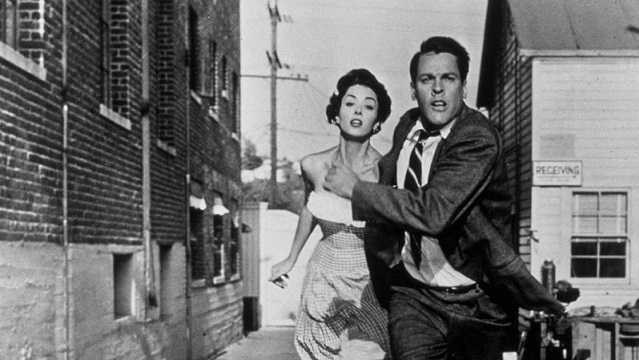
Top:   Dr. Miles J. Bennell (Kevin McCarthy) and Becky Driscoll (Dana Wynter) struggle to escape Santa Mira;
Above:  Theodora 'Teddy' Belicec (Carolyn Jones) watches uneasily over the partially replaced body of her husband, Jack (King Donovan)


Originally serialized in Colliers Magazine in 1954, Jack Finney's science fiction novel about a small town being invaded by seeds that have drifted to Earth from space, the film rights were picked up by Academy Award winning producer Walter Wanger shortly after its original publication. Wanger quickly hired Don Seigel to direct, who then brought on Daniel Mainwaring to collaborate on the screenplay (the two having worked together on The Big Steal, in which Mainwaring used the pseudonym Geoffrey Homes). Development of Invasion of the Body Snatchers began in the immediate aftermath of Senator Joseph McCarthy's Hollywood Blacklist - where industry professionals were denied unemployment after being accused (mostly falsely) of being subversives or Communists - and many involved in pre-production believed Seigel and Mainwaring's screenplay (as well as Finney's original novel) was a subtle statement against McCarthyism. Actress Dana Wynter (who plays Becky Driscoll) later agreed with that sentiment, although she didn't recall the mention of any political statements on-set, while star Kevin McCarthy (who played the character Dr. Miles Bennell) believed the film to be an attack on "Madison Avenue" attitudes - interestingly, Siegel joked that the pods actually represented movie industry executives!

Initially, Wanger considered Gig Young, Dick Powell, Joseph Cotten, and several others for the role of Miles, and Anne Bancroft, Donna Reed, Kim Hunter, Vera Miles and others for the part of Becky - but due to the low budget of the picture, Wanger  abandoned these choices and cast Richard Kiley, who had just starred in The Phoenix City Story for Allied Artists. However, Kiley turned the role down and Wanger soon cast two relative newcomers in the lead roles: Kevin McCarthy, who had just starred in Siegel's An Annapolis Story, and Dana Wynter, who had done several major dramatic roles on television. McCarthy didn't particularly like the script because he felt that, in streamlining the novel for the screen, depth of character was lost. He thought it was a mistake that these fairly sophisticated, educated characters had such bland dialogue and manner of relating to one another, "lacking the curves and nuances that you often hear in the conversation of ordinary, mature men and women."


TRIVIA:   During its original release, papier-mâché pods were on display in theater lobbies, as well as black-and-white cutouts of Kevin McCarthy and Dana Wynter running frantically away from a crowd of pod people.
 Top:   Becky watches in horror as a pod hatches;
Above:   With Santa Mira now overrun with pod people, Miles and Becky are chased through the streets by the alien replicants!


Originally, Wanger and Siegel wanted to film Invasion of the Body Snatchers on location in Mill Valley, California, the town just north of San Francisco, that Finney described in his novel,  location proved too expensive and Siegel with Allied Artist executives found locations resembling Mill Valley in the Los Angeles area, including Sierra Madre, Chatsworth, Glendale, Los Feliz, Bronson and Beachwood Canyons, all of which would make up the town of "Santa Mira" for the film. With a shooting schedule of 20 days (and a budget of $350,000) and no second unit to assist with pick up shots, the cast and crew were required to work six days a week. The pace of the shooting meant there was little time for the actors to rest between takes of the exhausting chase sequences. And there was no time to discuss scenes - Wynter said the actors were always responsible for mentally rehearsing their characters and actions before jumping in front of the cameras.

Production Designer Ted Haworth came up with a fairly simple and inexpensive (about $30,000 total) idea for creating the pods and for the most difficult effect when the pods burst open, revealing the likenesses of the actors. The actors had to have naked impressions of themselves made out of thin, skin-tight latex, which involved being submerged in the very hot casting material with only a straw in their mouths to breathe through, which was grueling for the actors, especially Carolyn Jones (who plays "Teddy" Belicec), who was claustrophobic. Wynter recalled, "I was in this thing while it hardened, and of course it got rather warm! I was breathing through straws or something quite bizarre, and the rest of me was encased, it was like a sarcophagus. The guys who were making it tapped on the back of the thing and said, 'Dana, listen, we won't be long, we're just off for lunch [laughs]!' In the end, we had to be covered except for just the nostrils and I think a little aperture for the mouth."

TRIVIA:   The tunnel scene where the hero hides briefly from the townspeople was filmed at Bronson Cave in Griffith Park, but the location would later come to be more famously known as the Bat Cave from the 1960's Batman TV series!

The last sequence was shot, not on the actual Hollywood Freeway (as depicted in the film), but on a little used cross-bridge. Cars were driven by stunt drivers, although Siegel said later that McCarthy was in real danger of getting hit, because the sequence was shot at dawn and he was near complete exhaustion. Production finally wrapped, going over schedule by three days because of night-for-night shooting that Siegel wanted, on 27 April, 1955.


Above:   Miles Bennell: They're here already! You're next! You're next!


Invasion of the Body Snatchers was originally meant to end with Miles screaming as truckloads of pods pass him by, but Allied Artists were wary of a pessimistic conclusion, insisted on adding a prologue and epilogue to the movie suggesting a more optimistic outcome to the story, which is thus told mainly in flashback. In this version the film begins with a ranting Bennell in custody in a hospital emergency ward. He then tells a consulting psychiatrist (Whit Bissell) his story. In the closing scene pods are found at a highway accident, confirming his warning. The Federal Bureau of Investigation is notified. For the prologue, Wanger wanted a Winston Churchill quotation as a preface, with Orson Welles doing the narration. When they couldn't persuade Welles, Wanger tried to enlist science-fiction author Ray Bradbury, although he declined as well. In his autobiography Siegel added that "Wanger was very much against this, as was I. However, he begged me to shoot it to protect the film, and I reluctantly consented […]". During test screenings, much of the film's original humor and humanity was subsequently cut when the audience found it difficult to follow and laughed at all the wrong moments. The studio insisted on edits because it wasn't policy of the day to mix humor with horror.

Released on February 5th, Invasion of the Body Snatchers was largely ignored by critics on its initial run, despite grossing over $3 million at the box office. Contemporary critics, however, have since agreed that the film is one of the best science-fiction horror films of the 20th century, with Leonard Maltin describing Invasion of the Body Snatchers as "influential, and still very scary". Tom Huddleston of Time Out wrote, "This modest, sci-fi-inflected 1956 horror movie may come to be seen as the defining metaphorical work of the twentieth century", with Tim Robey from the Daily Telegraph adding, "[the film is] brilliantly placed, however unwittingly, to illustrate America's political paranoia from both ends."

Hollywood would remake Jack Finney's novel a further three times between 1978 and 2007; Invasion of the Body Snatchers (1978), - directed by Philip Kaufman starring Donald Sutherland - Body Snatchers (1993), and The Invasion (2007), starring Nicole Kidman and produced by The Wachowskis siblings. However, in reference to critical acclaim and box office gross, only the 1978 version came close to matching the original Invasion of the Body Snatcher's success. In 1994, Invasion of the Body Snatchers was selected for preservation in the United States National Film Registry by the Library of Congress as being "culturally, historically, or aesthetically significant", ensuring the movie's legacy as a cult classic horror film for generations to come.


ROTTEN TOMATOES SCORE:   98%

_________________________________________


Saturday, 4 February 2017


ON THIS DAY IN HORROR - February 4th
"SCREAM 3" released in 2000


While Sidney and her friends visit the Hollywood set of Stab 3, the third film based on the Woodsboro murders, a new Ghostface begins to terrorize them once again, in Wes Craven's Scream 3!


Don't miss out on future blogs, trailers, and clips IHdb has coming up
by Following IHdb's Facebook page above


Cotton Weary (Liev Schreiber), now living in Los Angeles and the host of a nationally syndicated television show, 100% Cotton, is called by Ghostface, who demands the whereabouts of Sidney Prescott, who has gone into hiding ever since the events of the second film three years ago. Cotton refuses to cooperate, and when Ghostface comes to his home, both Cotton and his girlfriend Christine (Kelly Rutherford) are murdered.

Detective Mark Kincaid (Patrick Dempsey) contacts Gale Weathers (Courteney Cox) to discuss the murders, prompting her to travel to Hollywood, where she finds Dewey Riley (David Arquette) working as an adviser on the set of Stab 3, the third film in the film within a film series based on the Ghostface murders. Using a voice changer as a ruse, Ghostface kills Stab 3 actress Sarah Darling (Jenny McCarthy). Meanwhile, Sidney is now living in a secluded rural house as a crisis counselor for an abused women's hotline, as she is fearful that another killer may strike. Having discovered Sidney's number, the killer begins taunting her by phone, forcing her out of hiding and drawing her to Hollywood. As the remaining Stab 3 cast, along with Dewey and Gale, gather at the home of Jennifer Jolie (Parker Posey), Ghostface kills her bodyguard Steven Stone (Patrick Warburton) and uses a gas leak to cause an explosion, killing fellow actor Tom Prinze (Matt Keeslar) in the process.

Martha Meeks (Heather Matarazzo), the sister of Sidney's friend Randy, who was attacked and murdered by Ghostface in the previous film, visits Sidney and the others to drop off a videotape that Randy had made before his death, posthumously warning them that the rules of a horror movie franchise in the third and final film do not apply to anyone, and that any of them, including Sidney, could die. As Dewey, Gale, Jennifer, and the remaining Stab 3 actors, Angelina Tyler (Emily Mortimer) and Tyson Fox (Deon Richmond), attend a birthday party for Stab 3's director Roman Bridger (Scott Foley), the stage is set for one more deadly confrontation between Sidney and the latest Ghostface; which reveals a deadly secret from Sidney's past that she would never see coming!


[Sidney, Dewey, Gale and Randy's sister, Martha, watch Randy's posthumous tape]
Dewey: [referring to the tape] Trilogy?
Randy: That's right, it's a rarity in the horror field but it does exist, and it is a force to be reckoned with. Because true trilogies are all about going back to the beginning and discovering something that wasn't true from the get go. Godfather, Jedi, all revealed something that we thought was true that wasn't true. So if it is a trilogy you are dealing with, here are some super trilogy rules: 1. You got a killer who's going to be super human. Stabbing him won't work. Shooting him won't work. Basically in the third one you gotta cryogenically freeze his head, decapitate him, or blow him up. 2. Anyone including the main character can die. This means you Syd. I'm sorry. It's the final chapter. It could be fucking 'Reservoir Dogs' by the time this thing is through. Number 3. The past will come back to bite you in the ass. Whatever you think you know about the past, forget it. The past is not at rest. Any sins you think were committed in the past are about to break out and destroy you. So in closing, let me say good luck, god speed, and for some of you, I'll see you soon. 'Cause the rules say some of you ain't gonna make it. I didn't, not if you're watching this tape.
Top:   Sidney (Neve Campbell), Dewey (David Arquette) and Gale (Courtney Cox-Arquette) are drawn into another series of grisly murders;
Above:   Detective Mark Kincaid (Patrick Dempsey) joins the investigation


Before the release of Scream 2, Dimension Films had already greenlit a third film in the Scream-series, with a budget of over $40 million; significantly higher than the $14 million budget for the first Scream. Screenwriter Kevin Williamson's involvement had been contracted while selling his Scream script, to which he had attached two five-page outlines for potential sequels, what would become Scream 2 and Scream 3, hoping to entice buyers with the prospect of purchasing a franchise rather than a single script. Likewise, director Wes Craven too had been contracted for two potential sequels following a successful test screening of Scream and he returned to direct the third installment. However, following his successes with the Scream series and other projects such as I Know What You Did Last Summer, Williamson had become involved in multiple projects including the development of the short-lived TV series Wasteland and directing his self-penned film Teaching Mrs. Tingle (1999) which Williamson had written prior to Scream and which had languished in development hell since.' The Weinsteins hired Arlington Road scribe Ehren Kruger to replace Williamson and helm writing duties, developing a script based on Williamson's  20-30 page draft outline.

To help in developing the script, Kruger read copies of Williamson's scripts for Scream and Scream 2 as well as watching the earlier films to better understand the characters and tone, but his lack of involvement with the development of the principal cast of Scream hampered his ability to portray them true to their previous characterization. Early scripts had the character of Sidney Prescott much like "Linda Hamilton in Terminator 2" - a more action-orientated heroine - at which point Craven would intervene and correct the script to bring the characters closer to their previous appearances. With the start of principal photography looming, Craven himself completed some rewrites, while Kruger himself was constantly on set rewriting scenes - in some cases completed the same day they were to be filmed. Throughout production, the actors would constantly complain about the frequent rewrites, which Craven cheekily included in the final film with the actors of "Stab 3", the movie-within-the-movie, complaining about rewrites and the three different scripts.

Neve Campbell, Courteney Cox, David Arquette and Liev Schreiber all returned to their roles as Sidney Prescott and news reporter Gale Weathers, Dewey Riley and Cotton Weary, now host of a TV show. Scheduling however proved more difficult than previous installments in the Scream series since  their busy schedules made arranging their availability with the film's production period difficult. case in point, Campbell was concurrently shooting the movie Drowning Mona, as well as her TV series Party of Five during the production of this film, which meant she was only available to film her role for 20 days forcing the script to reduce the series' main character to a smaller role while focusing on the other characters played by Cox and Arquette (and since her Drowning Mona character had long, streaked hair, Campbell had to wear a wig to play Sidney Prescott, which required two hours application time each morning). Roger L. Jackson again returned to voice the antagonist Ghostface and Jamie Kennedy reprised his role as Randy Meeks in spite of the character's death in Scream 2. Negative feedback following the death of Randy had the production consider methods to have had his character survive to appear in Scream 3 including having the character's family hide him away for safety while recuperating from his injuries, but it was deemed too unbelievable and the idea was replaced with the character appearing in a minor role via a pre-recorded video message.


TRIVIA:   Angelina Tyler (Emily Mortimer) was supposed to be the second killer, as Roman Bridger's girlfriend and ex-classmate of Sidney from Scream, but the producers didn't like the idea.
Top and Above:   Stab 3 actress Sarah Darling (Jenny McCarthy) is stalked by Ghostface!


Many of the supporting cast played fictitious actors taking part in the film within a film Stab 3, including Emily Mortimer as Angelina Tyler, Parker Posey as Jennifer Jolie, Matt Keeslar as Tom Prinze, Jenny McCarthy as Sarah Darling and Deon Richmond as Tyson Fox with Scott Foley as the film's director, Roman Bridger. Interestingly, it was only after English actress Mortimer had been cast that the production discovered that she didn't have a permit to work in the States, in which Mortimer was flown to Canada where she was able to obtain the correct permit just as production got underway. The remaining cast included Lance Henriksen as film producer John Milton, Patrick Dempsey as detective Mark Kincaid (Dempsey being hired the day before shooting began and had one night to learn three big dialog-heavy scenes!), Patrick Warburton as bodyguard Steven Stone, and Kelly Rutherford as Christine Hamilton, girlfriend to Cotton Weary. Scream 3 also featured several cameo appearances including the fictional characters of Jay and Silent Bob from the 1994 film Clerks played by Jason Mewes and Kevin Smith, and director Roger Corman as an on-set studio executive. Carrie Fisher made a cameo in the film as former actress, Bianca Burnette, at the suggestion of Bob Weinstein, with Fisher helping to write her character.

Principal photography for Scream 3 began on July 6, 1999 in and around Hollywood, Los Angeles. The opening scene involves Cotton Weary (Schreiber) driving before arriving home where he is murdered by the Ghostface character, was originally filmed on Holloywood Boulevard, but the following scene in Cotton's apartment was changed frequently, requiring alterations to the driving scene to maintain continuity, modifying who speaks to Cotton by phone and what the conversation entailed. Unable to return to Hollywood Boulevard, the scene was reshot on a street outside of the production studio in San Fernando Valley and intermixed with footage taken on the Boulevard. Likewise, the opening attack scene was filmed partially at the exterior and interior of Harper House in West Hollywood but changes were made to the scene including introducing a live girlfriend for Cotton instead of her being dead when Cotton arrives. It was later decided that the confrontation between Cotton and Ghostface, featuring Cotton physically dominating the character and attempting to escape by skylight, was unrealistic and made Ghostface appear weak and this scene was reshot. Again however, they were unable to return to Harper House to conduct filming and resorted to constructing a replica of the apartment interior to produce the necessary footage which had the Ghostface character appear more dominant and completely excised the attempted skylight escape.

Since scenes were being constantly rewritten on set - to avoid the complications resulting from shooting the opening scene - Craven the production team purposely filmed large amounts of footage containing different variations of each scene based on the different script developments in order that, should the script further change, they would ideally have a scene they could use without having to film new ones at a later date, requiring them to obtain access to locations or build sets. In fact, the three-minute scene featuring the character of Randy Meeks had over two-hours of footage filmed, and three versions of the epilogue scene were filmed with Patrick Dempsey's character - one with him absent, one where his arm is bandaged and one with him in a normal condition - as the production were not certain if his character should survive or be killed off!


TRIVIA:   When Sidney jumped over the bar and stabbed the killer in the back with an icepick, Neve Campbell missed the pad that she was supposed to plunge the pick into and actually hit flesh. Scott Foley's scream is genuine.
Top:   Director Wes Craven on location with David Arquette and Courtney Cox-Arquette, and with Neve Campbell at the Scream 3 premiere (Above)


Three months after completing principal photography for Scream 3, the ending was refilmed when it was decided to be an inadequate conclusion - originally the ending consisted of Sidney easily defeating Roman which led into an early morning scene of police arriving and then into the final scene of Sidney in her home. The production considered that this amounted to essentially three endings, damaging the pacing of the film and there was also consideration that, being the concluding chapter of the trilogy, the audience needed to believe that Sidney could lose and die, something her easy victory did not achieve. To create the alternate ending, the fight scene between Sidney and Roman was extended and an addition involved Roman shooting Sidney, seemingly to death where previously she had simply hidden from the character. As with production of Scream, Craven encountered repeated conflicts over censorship with the MPAA regarding violence, with the director stating in an interview that the issues made him consider leaving the horror genre.

Released in February, Scream 3 was the least financially successful film of the series (at the time), grossing a little under $90 million at the US box office, and received the worst reviews of the franchise. Time Out London was particularly critical of the film, calling the film's metafiction commentary a poor imitation of Craven's own horror film Wes Craven's New Nightmare (1994). Roger Ebert said "[the characters] are so thin, they're transparent" but praised Campbell's appearance saying, "The camera loves her. She could become a really big star and then giggle at clips from this film at her AFI tribute." In a positive review, The Los Angeles Times called the film, "Genuinely scary and also highly amusing", while Variety also praised the film as the end of the Scream trilogy, saying "Aficionados will be the best able to appreciate how wittily Craven has brought down the curtain on his much-imitated, genre-reviving series".


ROTTEN TOMATOES SCORE:   31%

______________________________________


ON THIS DAY IN HORROR - February 4th
"VIDEODROME" released in 1983


MINI BLOG


A sleazy cable-TV programmer begins to see his life and the future of media spin out of control in a very unusual fashion when he acquires a new kind of programming for his station, in David Cronenberg's Videodrome!


Don't miss out on future blogs, trailers, and clips IHdb has coming up
by Following IHdb's Facebook page above


A sleazy cable-TV programmer, Max Renn (James Woods), is always looking for new cheap and erotic movies for his station, Civic TV Channel 83. When his employee, Harlan (Peter Dvorsky), decodes a pirate video broadcast showing torture, murder, and mutilation called Videodrome, Max becomes obsessed to get this series for his channel. He contacts his supplier, Masha (Lynne Gorman), and asks her to find the party responsible for the transmission. A couple of days later, Masha tells that Videodrome is real snuff movies, which arouses Renn's sado-masochistic girlfriend Nicki Brand (Deborah Harry) who decides to travel to Pittsburgh, where the show is based, to audition. Max investigates further, and through a video by the media prophet Brian O'Blivion (Jack Creley), the creator and Videodrome, and learns that Videodrome is more than a TV show - it's an experiment that uses regular TV transmissions to permanently alter the viewer's perceptions by giving them brain damage. Max is caught in the middle of the forces that created Videodrome and the forces that want to control it, while his body itself is turning into the ultimate weapon to fight this global conspiracy!


[O'Blivion appears on the TV screen, speaking with Renn]
Brian O'Blivion: The battle for the mind of North America will be fought in the video arena: the Videodrome. The television screen is the retina of the mind's eye. Therefore, the television screen is part of the physical structure of the brain. Therefore, whatever appears on the television screen emerges as raw experience for those who watch it. Therefore, television is reality, and reality is less than television.
Top:   TV producer Max Renn (James Woods) introduces his girlfriend, Nicki Brand (Deborah Harry) to Videodrome;
Above:   The creator of Videodrome, the media prophet Barry O'Blivion (Jack Creley)


David Cronenberg recalled how, when he was a child, he used to pick up television signals from Buffalo, New York, late at night after Canadian stations had gone off the air, and how he used to worry he might see something disturbing not meant for public consumption, which began the first ideas for Videodrome. After 10-years as a director, helming such cult classic horror films such as Shivers and Scanners, Cronenberg returned to the idea of Videodrome. Cronenberg cast James Woods in the lead role of sleazy TV producer Max Renn, Deborah Harry as Nicki Brand, with a supporting cast including Peter Dvorsky, Sonja Smits, Leslie Carlson, and Jack Creley as Renn's TV technician Harlan; O'Blivion's daughter Bianca; head of Spectacular Optical, Barry Convex; and media messiah Barry O'Blivion, respectively.

During filming of the Cathode Ray mission sequence, the film's gaffer, Jock Brandis, walked in and casually informed the crew that the power lines to the building were smoking because of the load imposed on them by the TV sets. For the chest-slit sequences, Woods lay down in a hole built into a couch with the chest-slit apparatus glued onto him. Woods swore he would never work with anything that had to be glued onto him ever again! During filming the sequences with the flesh-gun (which "fired" bursts of cold, vaporous gas), Woods played a prank on Cronenberg by smearing his (real) hand with blue paint and pretending he had frostbite.  


TRIVIA:   The videotapes used in the film (at least as key props) are Betamax format. This is because VHS cassettes were too large to fit into the false stomach for special effects scenes.
Top and Above:   As Renn's exposure to Videpdrome increases, he starts to experience severe hallucinations and even his own body starts to mutate!


An epilogue was planned but never filmed. In it, Max Renn, Bianca O'Blivion and Nicki Brand appear on the set of Videodrome. Bianca and Nicki are shown to have chest slits of their own, from which emerge strange mutated sex organs - this concept was also used in one of Cronenberg's earlier films, Rabid (1977). The scene was scrapped along with many others due to cost overruns, bad timing (Harry had stomach flu and Woods was visiting relatives), and the sheer difficulty of executing such a special-effects scene. A number of other ambitious special effects sequences were also dropped.

Among the scenes that were scripted but deleted was one where Max Renn's TV rises up out of his bathtub, while showing an image. The crew had researched how to do this - there had been talk of having the actor in the tub - and had come up with several solutions. One involved filling the tub with a clear fluid that was non conductive, but that would have cost $25 a quart. The crew eventually decided to take a real TV and simply cover its insides with layers of waterproofing insulation. It worked - they dunked the TV into a swimming pool and found, to their astonishment, that TVs float due to the ultra-high vacuum inside the picture tube. The scene was axed just before it was to be filmed.

Although considered a box office flop at it's time of release, Videodrome received generally positive reviews, with Variety writing, "[the film] is dotted with video jargon and ideology which proves more fascinating than distancing. And Cronenberg amplifies the freaky situation with a series of stunning visual effects." Despite its poor commercial performance, Videodrome also won a number of awards upon its release, including tying with with Bloodbath at the House of Death for Best Science-Fiction Film at the 1984 Brussels International Festival of Fantasy Film and was nominated for eight Genie Awards with David Cronenberg tying with Bob Clark's A Christmas Story for Best Achievement in Direction. In 2009, Universal Studios announced that it had obtained the rights to produce a remake of Videodrome, with Ehren Kruger beging named to write the script and produce the film with partner Daniel Bobker - but the project seems to have been abandoned since. 


ROTTEN TOMATOES SCORE:   78%

 ____________________________________


Friday, 3 February 2017


ON THIS DAY IN HORROR - February 3rd
"WHEN A STRANGER CALLS" released in 2006

MINI BLOG


A young high school student babysits for a very rich family. She begins to receive strange phone calls threatening the children. When she finally realizes that it's not a joke, she calls the police, only to find that the caller is a lot closer than she thinks, in the remake of the 1979 cult horror film, When A Stranger Calls!


Don't miss out on future blogs, trailers, and clips IHdb has coming up
by Following IHdb's Facebook page above


High school track star Jill Johnson (Camilla Belle) is going through a teenage crisis; her boyfriend, Bobby (Brian Geraghty), cheat on her with her best friend Tiffany (Katie Cassidy), and - as a punishment for running up a huge cell-phone bill - her parents arew forcing her to babysit the same night of a school bonfire.  Jill arrives at an elaborate lakehouse, which has a greenhouse built in the center, and is greeted by The parents Dr and Mrs. Mandrakis's (Derek de Lint and Kate Jennings Grant), who show her around and tell her about their live in housemaid Rosa (Rosine Ace Hatem). As the kids, Will and Allison (Arthur Young and Madeline Carroll) are sleeping upstairs, Jill spends the first hour indulging in secret babysitter pleasures like snooping and trying on Mrs. Mandrakis's jewelry. Soon enough however, Jill takes to receive a series of prank calls; benign calls at first, that quickly escalate into violent threats and suggestions that the caller is outside watching her. Jill calls the police, who tell her they can trace the calls if she is able to keep him on the line for one minute. The unknown stalker continues to remain quiet on the other end as Jill tries to keep him talking for 60 seconds so the call can be traced by the police, she desperately asks the man on the phone "What do you want?!". He replies "Your blood.....all over me" As Jill hangs up instantly, the police call back right away telling her that the calls are coming from inside the house!


TRIVIA:   Tommy Flanagan sang a Broadway version of his infamous "your blood all over me" line to Camilla Belle in between scenes.
Top:   Teenager Jill Johnson (Camilla Belle) is terrorized by phones throughout the night by a mysterious, and vicious, Stalker (Tommy Flanagan) (Above)


Reportedly, Screen Gems had greenlit a sequel rumored to be titled When a Stranger Returns in which Hayden Panettiere was to play the babysitter, but the studio later cancelled the project. In early 2005 however, actor/writer Jake Wade Wall adapted Steve Feke's screenplay, excluding the last 50 minutes of the original material and expanded the babysitter story line (which in the original film only lasts for 20 minutes of screen time). Director Mary Harron was offered to helm the film after her work on American Psycho (2000), before English film director Simon West (known mostly for big budget action pictures such as Con Air and Lara Croft: Tomb Raider) was chosen.

Evan Rachel Wood turned down the role of Jill Johnston, before producers approached Camilla Belle. Belle herself almost turned down the part due to her personal dislike for horror films, before West convinced her that he was going for a more psychological thriller direction. Belle then accepted the part, turning down another role in a horror remake, Black Christmas, to star in When A Stranger Calls (ironically, Katie Cassidy - who makes her film debut with this film - would go on to star in Black Christmas six months after filming wrapped). Even though the stranger is played by Scottish-born actor Tommy Flanagan, the voice in the phone-calls is actually Lance Henriksen's, with West stating, "Henriksen fit the voice, whereas Flanagan fit the build of the stranger."

Principal photography began on January 1, 2005, with Bellarmine-Jefferson High School was used to portray the high school seen in the film while Signal Hill was used to portray the carnival shown in the film. The exterior of the Mandrakis' house built on the shores of a unused reservoir, Running Springs, with the interiors built on a soundstage in Culver Studios. During filming, Belle was told to hit Tommy Flanagan during the scene in the atrium. She missed him and punched the bridge instead, cutting her knuckle and scarring her hand. Belle also really did slam her head into a glass window during the fight on the stairs. 


Above:   Director Simon West on set with star Camilla Belle

TRIVIA:   The voice of "Stacy", the unseen girl during the opening credit sequence, and victim of the killer that targets Jill, is that of director Simon West's 12 year old daughter Lillie.


West opted not to show the crime scene Detective Hines (played by Steve Eastin) has to see at the beginning of the movie to secure a PG-13 rating. To promote the movie,  AOL Instant Messenger ran ads beckoning users to IM Jill020306. When messaged, "Jill" (a Colloquis-style program) made small talk before panicking, as she received calls from a stranger asking her to check the children.

When A Stranger Calls grossed an impressive $21,607,203 in its opening weekend, eventually grossing $47.9 million in the domestic box office, and another $19 million internationally. Despite the box office, reviews for the movie where mostly negative, with Time Out's Nigel Floyd writing, "If you've seen either Black Christmas or Halloween, there's nothing new here: the hyped-up score keeps telling us we ought to be scared, but the suspense feels mechanical and fake." Critic Robert Hanks reviewed, "I can't help feeling that this updating could have been a little more imaginative - the only wrinkle on the basic plot is that it uses mobile phones", while Matthew Turner of View London observed When A Stranger Calls was, "... atmospheric but generally disappointing thriller, despite a passably tense climax and an eye-catching performance by newcomer Camilla Belle." Reel Times Mark Pfeiffer offered a rare positive review, stating, "When a Stranger Calls understands that when alone and isolated in an unfamiliar place, an overactive imagination can be as frightening as any real threats."


ROTTEN TOMATOES SCORE:   9%

__________________________________


ON THIS DAY IN HORROR - February 3rd
"IN THE MOUTH OF MADNESS" released in 1995

MINI BLOG


An insurance investigator begins discovering that the impact a horror writer's books have on his fans is more than inspirational, in the third film in John Carpenter's Apocalypse Trilogy, In the Mouth of Madness!


Don't miss out on future blogs, trailers, and clips IHdb has coming up
by Following IHdb's Facebook page above


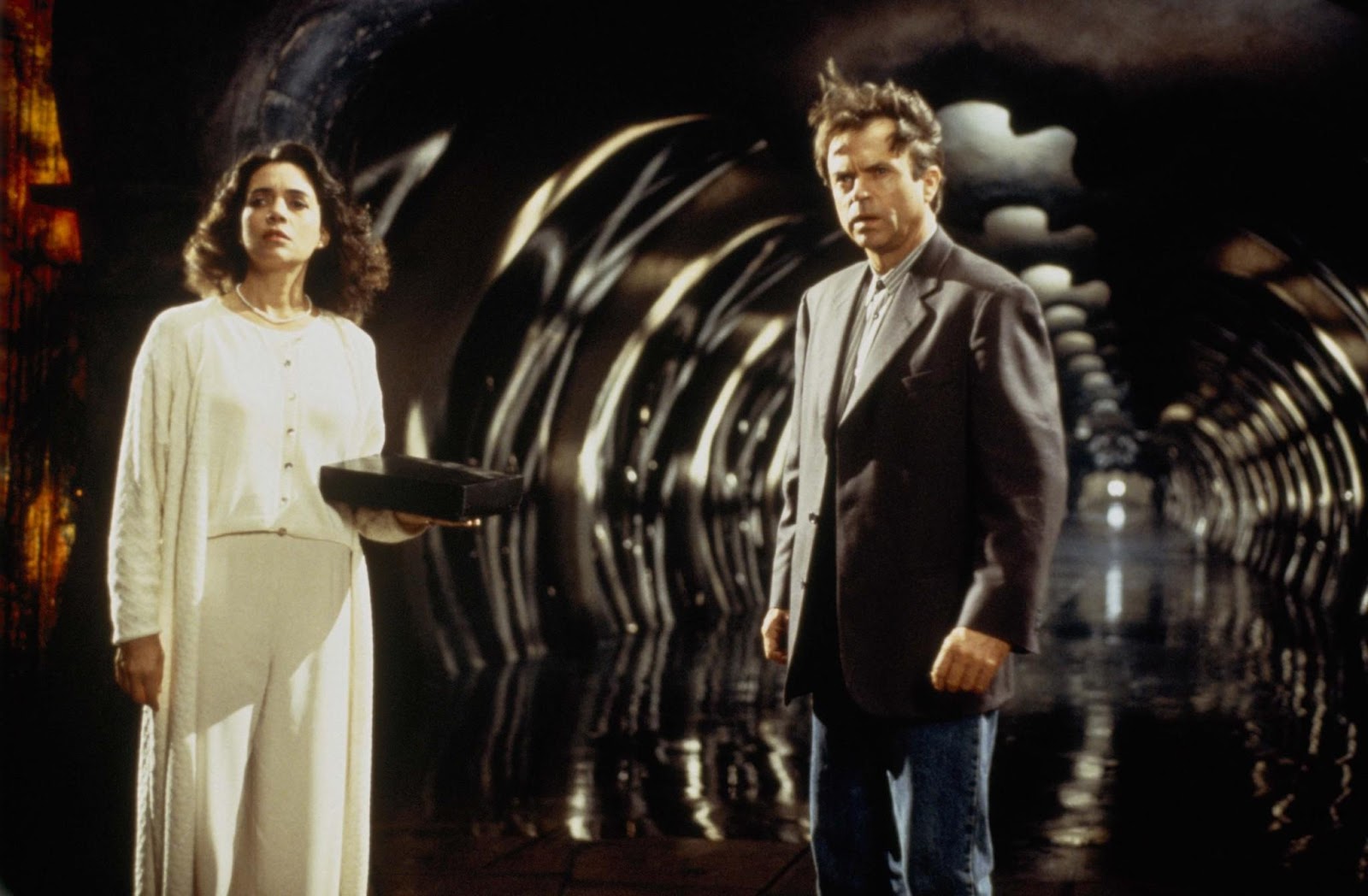
Efficient, and skeptical, freelance insurance investigator John Trent (Sam Neill) is hired by Arcane Publishing director Jackson Harglow (Charlton Heston) to investigate the dissappearence of its star author, horror writer Sutter Cane (Jürgen Prochnow) - and more importantly, recover the manuscript for Cane's final novel. Trent is partnered with Cane's editor, Linda Styles (Julie Carmen), who  explains that Cane's stories have been known to cause disorientation, memory loss and paranoia in "less stable readers". Convinced that the disappearance is a publicity stunt, Trent notices red lines on Cane's book's covers which, when aligned properly, form the outline of New Hampshire and mark a location alluded to be Hobb's End, the fictional setting for many of Cane's works. As Trent and Styles travel to New England, Styles experiences bizarre phenomena during the late-night drive before inexplicably arriving in Hobb's End, suddenly in broad daylight. Trent and Styles search the small town, encountering people and landmarks described as fictional in Cane's novels, especially the Black Church on the outskirts of town. After witnessing the townspeople attacked by a pack of vicious dogs outside the church, Trent confronts Styles, who admits that Arcane Publishing's claim was a stunt to promote Cane's book, but the time distortion and exact replica of Hobb's End were not part of the plan, suggesting that somehow Cane's books are becoming reality. Later, Styles confronts Cane at the Black Church. Cane exposes her to his final novel, In The Mouth of Madness, which drives her insane. Meanwhile, Trent repeatedly tries to leave Hobb's End, but keeps getting teleported back to the center of town, and evetually crashes his car. Trent wakes up in the Black Church, where Cane explains that the public's belief in his stories has freed an ancient race of monstrous beings, the Old Ones, which will reclaim the Earth. Cane then further reveals that Trent is merely one of his characters, who must follow Cane's plot and return the manuscript of In The Mouth of Madness to Arcane Publishing, furthering the end of humanity!

John Trent: [speaking with a psychiatrist] You're waiting to hear about my 'them', aren't you?
Dr. Wrenn: Your what?
John Trent: My 'them'. Every paranoid schizophrenic has one; a 'them', a 'they', an 'it'. And you want to hear about my 'them', don't you?
Dr. Wrenn: I want to know how you got here.
John Trent: Things are turning to shit out there, aren't they?
Top:   Skeptic insurance investigator John Trent (Sam Neill) joins forces with book editor Linda Styles (Julie Carmen) to find reclusive horror author, Sutter Cane (Jürgen Prochnow) (Above)


Michael De Luca first wrote the script in the late 1980's. Although his character Sutter Cane might appear to be representative of author Stephen King, De Luca more likely based the character on H. P. Lovecraft, with Hobb's End based more on Lovecraft's Arkham rather than King's Castle Rock. The plot of the film also more closely resembles something Lovecraft might have written, focusing on the effects that horrific occurrences have on one's sanity, rather than on the external horrors that most of King's writings lean towards. Even the title, In the Mouth of Madness, appears to be an homage to Lovecraft and his story, At the Mountains of Madness. Also, references to the "Old Ones" by Sutter Cane, along with certain representations of monsters printed on his books and latter brought to life, are allusions to The Cthulhu Mythos - a series of stories by H.P. Lovecraft and continued by other writers into modern times (in this sense, one could consider In the Mouth of Madness Carpenter's own contribution to The Cthulhu Mythos). 

One of the first directors he offered it to was John Carpenter, who initially passed on the project. New Line Cinema later announced production in 1989 with director Tony Randel attached to direct (and later Mary Lambert when Randel dropped out). Production stalled however, and three years later Carpenter returned to the project, with filming taking place from August to October 1993, in Ontario, Canada. The exterior of the Black Church seen in Hobb's End is actually the Cathedral of the Transfiguration, a Slovak Byzantine Rite Roman Catholic former cathedral located in Markham (outside Ontario). The building used as the mental institution at the beginning of the film is actually a water filtration plant in the Beaches area of Toronto.

John Trent: [speaking with a psychiatrist] Every species can smell its own extinction. The last ones left won't have a pretty time with it. In ten years, maybe less, the human race will just be a bedtime story for their children. A myth, nothing more.
Above:   Director John Carpenter on set


The dozens of monsters featured towards the end of the film were a combination of men in suits, animatronics and a full-sized "wall" of creatures. It took over thirty people to operate the monsters. At one point during filming of the "Wall of Monsters" sequence, the Wall of Monsters ran over Greg Nicotero's foot! The effect of Julie Carmen spinning her head around was done by having a contortionist stunt-double wear an up-side down prosthetic mask of Carmen's face. Since the stunt double couldn't see, the filmmaker had to guide her on where to go by sound. The demonic Mrs. Pickman creature was shot as a miniature (originally it was a man in a suit prosthetic, but Carpenter didn't find it convincing enough). When Jürgen Prochnow lets the monsters from the other side into our world, originally in the script the entire town was sucked into the other side. When this proved to be too costly, an effects artist over at Industrial Light and Magic recommended that instead he "tears" himself apart like paper.

Released in December 1994 in Italy, before its February release in the US, In the Mouth of Madness grossed a disappointing $3.5 million in its opening weekend, and earning only $9 million at the box office during its US theatrical run. Critics were mostly divided, offering mostly mixed reviews. Kevin Thomas from The Los Angeles Times wrote, "A thinking person's horror picture that dares to be as cerebral as it is visceral", while Roger Ebert (writing for the Chicago Sun-Times) noted, "One wonders how In the Mouth of Madness might have turned out if the script had contained even a little more wit and ambition." 


ROTTEN TOMATOES SCORE:   9%

___________________________________


Wednesday, 1 February 2017


ON THIS DAY IN HORROR - February 1st
"SUSPIRIA" released in Italy in 1977


A newcomer to a fancy ballet academy gradually comes to realize that the school is a front for something far more sinister and supernatural amidst a series of grisly murders, in Dario Argento's Suspiria!


Don't miss out on future blogs, trailers, and clips IHdb has coming up
by Following IHdb's Facebook page above


Suzy Bannion (Jessica Harper) travels to Germany to perfect her ballet skills at the prestigious Tanz Dance Academy. Arriving in the pouring rain, Suzy is refused admission after another woman, Pat (Eva Axén) is seen fleeing the school, calling out words that Suzy can barely make out in the rain. That night Pat is brutally murdered in her friend's apartment. The next morning, Suzy is finally admitted by  Madame Blanc (Joan Bennett), the vice-directress, and Miss Tanner (Alida Valli), one of the instructors. As the weeks go by, Suzy witnesses many strange things; she becomes mysteriously ill and is to be "medicated" with a glass of wine daily; the school becomes infested with thousands of maggots; and Daniel (Flavio Bucci), the blind pianist, is killed by his own guide dog. When Suzy's only friend at the academy, Sara (Stefania Casini), also abruptly "disappears" from the academy - in fact, Suzy has also been murdered by the dark figure that killed Pat - Suzy goes to meet one of Sara's acquaintances, a psychologist, Frank Mandel (Udo Kier), who explains that the academy was founded by Helena Markos, a cruel Greek émigré who was widely believed to be a witch. Finally remembering Pat's curses during the night of her arrival, Suzy returns to the school and finds a hidden passage in Madame Blanc's office and comes face-to-face with Helena Markos' evil coven, still very much alive and who have "plans" for Suzy!


TRIVIA:   The first part of Dario Argento's trilogy of films about the "Three Mothers" - completed with  Inferno (1980) and Mother of Tears (2007).
Top:   American Suzy Bannion (Jessica Harper) comes to Germany to study ballet, but gets more than she bargains for at the sinister Tanz Academy!;
Above:   Suzy befriends Sara (Stefania Casini)


Director/co-writer Dario Argento was originally inspired to make the film from the  stories told by Suspiria co-writer (and Dario's then-girlfriend) Daria Nicolodi's grandmother, who claimed to have fled from a German music academy because witchcraft was being secretly practiced there. Likewise, the film's finale was inspired by a dream that Nicolodi once had; in the dream she said she had encountered an invisible witch and, most bizarrely, there was a panther in the room with her that suddenly exploded. The dream was later written into the film - but it's a porcelain panther that explodes. Dario's first idea was that the ballet school would accommodate young girls not older than 12. However, the studio and producer Salvatore Argento (his father) denied his request because a film this violent involving children would almost certainly be banned. Dario raised the age limit of the girls to 20 but didn't rewrite the script, hence the naiveté of the characters and the occasionally childlike dialogue. He also put all the doorknobs at about the same height as the actress' heads, so they would have to raise their arms in order to open the doors, just like children.

As well as serving as the film's co-writer, Nicolodi was to have starred in the lead role of Suzy Bannion, but the studio insisted that an American actress be cast for the lead to make the film more marketable; actress Jessica Harper, having starred in Brian De Palma's Phantom of the Paradise. Nicolodi does however appear in the film twice - she can be glimpsed in the film's opening sequence that shows Suzy walking through the airport, and she also provides the gravelly voice of Helena Markos. The woman playing Helna Markos is not credited, but according to Harper, she was a 90-year-old ex-hooker who Dario found on the streets of Rome. Argento later cast Joan Bennett as Madame Blanc because of her association with director Fritz Lang, who Dario was a great admirer of, and Alida Valli as Miss Tanner. Stefania Casini, Barbara Magnolfi, Eva Axén and Udo Kier were later added to cast in the roles of Suzy's academy friends Sara and Olga, Pat Hingle, and Sara's psychologist friend Dr Frank Mandel respectively.


TRIVIA:   Suspiria means "to sigh" or "sighed", but also possibly "whispered". It has something to do with the difference in Italian & Spanish language stemming from the Latin root.
 Top and Above:   The Tanz Academy's teachers, Miss Tanner (Alida Valli) and Madame Blanc (Joan Bennett)


Harper later stated that many of the actors spoke different languages during shooting, mostly Italian and German, and it would make communicating difficult at times. However, since the film would be dubbed into English for American release, it was deemed not to be an issue during filming. In fact, since the film was going to be dubbed after principal photography, sound was rarely recorded during shooting. Harper added that it was strange to her to be in the middle of shooting a scene and hearing the background sound of a stagehand hammering away on another set in the studio. Udo Keir had a similar experience on set; since his appearance was rushed in the production schedule, Keir had little time to read the complete script. And so during his scene Harper, a crew person lay on the ground (behind the stone bench where he was sitting) and was telling him his lines as he spoke them to her!

Suspiria is noteworthy for several stylistic flourishes that have become Argento trademarks; the film was made with anamorphic lenses, the production design and cinematography emphasize vivid primary colors, particularly red, creating a deliberately unrealistic, nightmarish setting, emphasized by the use of imbibition Technicolor prints. The imbibition process, used for The Wizard of Oz and Gone with the Wind, is much more vivid in its color rendition than emulsion-based release prints, therefore enhancing the nightmarish quality of the film and was one of the final feature films to be processed in Technicolor.  


Above:   Director Dario Argento with "Helena Markos"


Released on February 1st in Italy (a full six months before its US release) Suspiria was huge commercial and critical success. Dave Kehr of the Chicago Reader gave a positive review, claiming that "Argento works so hard for his effects—throwing around shock cuts, colored lights and peculiar camera angles—that it would be impolite not to be a little frightened". Janet Maslin of The New York Times wrote a mixed review, saying the film had "slender charms, though they will most assuredly be lost on viewers who are squeamish", while critical consensus on the review aggregator site Rotten Tomatoes reads, "The blood pours freely in Argento's classic Suspiria, a giallo horror as grandiose and glossy as it is gory".

It was announced through MTV in 2008 that a remake of Suspiria was in production, to be directed by David Gordon Green, who directed films such as Undertow and Pineapple Express. As with many remakes of cult films, the announcement was met with hostility by some, including Argento himself. After a period of no news in which it was thought that the remake attempt had failed, until Green stated in August 2011 that he was again trying to remake the film. However, after another 3-years of development and legal complications, Green left the project. Finally in September 2015, filmmaker Luca Guadagnino was announced as new director at the 72nd Venice Film Festival, and in October 2016, it was announced that Chloe Grace Moretz would co-star in the remake, alongside Dakota Johnson, and Tilda Swinton. The film began shooting in Italy in late 2016, with actresses Swinton, Moretz, and Mia Goth being seen while filming in Varese, with additional filming expected to take place in Berlin in early 2017.


ROTTEN TOMATOES SCORE:   93%

_____________________________________