Saturday, 4 February 2017


ON THIS DAY IN HORROR - February 4th
"VIDEODROME" released in 1983


MINI BLOG


A sleazy cable-TV programmer begins to see his life and the future of media spin out of control in a very unusual fashion when he acquires a new kind of programming for his station, in David Cronenberg's Videodrome!


Don't miss out on future blogs, trailers, and clips IHdb has coming up
by Following IHdb's Facebook page above


A sleazy cable-TV programmer, Max Renn (James Woods), is always looking for new cheap and erotic movies for his station, Civic TV Channel 83. When his employee, Harlan (Peter Dvorsky), decodes a pirate video broadcast showing torture, murder, and mutilation called Videodrome, Max becomes obsessed to get this series for his channel. He contacts his supplier, Masha (Lynne Gorman), and asks her to find the party responsible for the transmission. A couple of days later, Masha tells that Videodrome is real snuff movies, which arouses Renn's sado-masochistic girlfriend Nicki Brand (Deborah Harry) who decides to travel to Pittsburgh, where the show is based, to audition. Max investigates further, and through a video by the media prophet Brian O'Blivion (Jack Creley), the creator and Videodrome, and learns that Videodrome is more than a TV show - it's an experiment that uses regular TV transmissions to permanently alter the viewer's perceptions by giving them brain damage. Max is caught in the middle of the forces that created Videodrome and the forces that want to control it, while his body itself is turning into the ultimate weapon to fight this global conspiracy!


[O'Blivion appears on the TV screen, speaking with Renn]
Brian O'Blivion: The battle for the mind of North America will be fought in the video arena: the Videodrome. The television screen is the retina of the mind's eye. Therefore, the television screen is part of the physical structure of the brain. Therefore, whatever appears on the television screen emerges as raw experience for those who watch it. Therefore, television is reality, and reality is less than television.
Top:   TV producer Max Renn (James Woods) introduces his girlfriend, Nicki Brand (Deborah Harry) to Videodrome;
Above:   The creator of Videodrome, the media prophet Barry O'Blivion (Jack Creley)


David Cronenberg recalled how, when he was a child, he used to pick up television signals from Buffalo, New York, late at night after Canadian stations had gone off the air, and how he used to worry he might see something disturbing not meant for public consumption, which began the first ideas for Videodrome. After 10-years as a director, helming such cult classic horror films such as Shivers and Scanners, Cronenberg returned to the idea of Videodrome. Cronenberg cast James Woods in the lead role of sleazy TV producer Max Renn, Deborah Harry as Nicki Brand, with a supporting cast including Peter Dvorsky, Sonja Smits, Leslie Carlson, and Jack Creley as Renn's TV technician Harlan; O'Blivion's daughter Bianca; head of Spectacular Optical, Barry Convex; and media messiah Barry O'Blivion, respectively.

During filming of the Cathode Ray mission sequence, the film's gaffer, Jock Brandis, walked in and casually informed the crew that the power lines to the building were smoking because of the load imposed on them by the TV sets. For the chest-slit sequences, Woods lay down in a hole built into a couch with the chest-slit apparatus glued onto him. Woods swore he would never work with anything that had to be glued onto him ever again! During filming the sequences with the flesh-gun (which "fired" bursts of cold, vaporous gas), Woods played a prank on Cronenberg by smearing his (real) hand with blue paint and pretending he had frostbite.  


TRIVIA:   The videotapes used in the film (at least as key props) are Betamax format. This is because VHS cassettes were too large to fit into the false stomach for special effects scenes.
Top and Above:   As Renn's exposure to Videpdrome increases, he starts to experience severe hallucinations and even his own body starts to mutate!


An epilogue was planned but never filmed. In it, Max Renn, Bianca O'Blivion and Nicki Brand appear on the set of Videodrome. Bianca and Nicki are shown to have chest slits of their own, from which emerge strange mutated sex organs - this concept was also used in one of Cronenberg's earlier films, Rabid (1977). The scene was scrapped along with many others due to cost overruns, bad timing (Harry had stomach flu and Woods was visiting relatives), and the sheer difficulty of executing such a special-effects scene. A number of other ambitious special effects sequences were also dropped.

Among the scenes that were scripted but deleted was one where Max Renn's TV rises up out of his bathtub, while showing an image. The crew had researched how to do this - there had been talk of having the actor in the tub - and had come up with several solutions. One involved filling the tub with a clear fluid that was non conductive, but that would have cost $25 a quart. The crew eventually decided to take a real TV and simply cover its insides with layers of waterproofing insulation. It worked - they dunked the TV into a swimming pool and found, to their astonishment, that TVs float due to the ultra-high vacuum inside the picture tube. The scene was axed just before it was to be filmed.

Although considered a box office flop at it's time of release, Videodrome received generally positive reviews, with Variety writing, "[the film] is dotted with video jargon and ideology which proves more fascinating than distancing. And Cronenberg amplifies the freaky situation with a series of stunning visual effects." Despite its poor commercial performance, Videodrome also won a number of awards upon its release, including tying with with Bloodbath at the House of Death for Best Science-Fiction Film at the 1984 Brussels International Festival of Fantasy Film and was nominated for eight Genie Awards with David Cronenberg tying with Bob Clark's A Christmas Story for Best Achievement in Direction. In 2009, Universal Studios announced that it had obtained the rights to produce a remake of Videodrome, with Ehren Kruger beging named to write the script and produce the film with partner Daniel Bobker - but the project seems to have been abandoned since. 


ROTTEN TOMATOES SCORE:   78%

 ____________________________________


Friday, 3 February 2017


ON THIS DAY IN HORROR - February 3rd
"WHEN A STRANGER CALLS" released in 2006

MINI BLOG


A young high school student babysits for a very rich family. She begins to receive strange phone calls threatening the children. When she finally realizes that it's not a joke, she calls the police, only to find that the caller is a lot closer than she thinks, in the remake of the 1979 cult horror film, When A Stranger Calls!


Don't miss out on future blogs, trailers, and clips IHdb has coming up
by Following IHdb's Facebook page above


High school track star Jill Johnson (Camilla Belle) is going through a teenage crisis; her boyfriend, Bobby (Brian Geraghty), cheat on her with her best friend Tiffany (Katie Cassidy), and - as a punishment for running up a huge cell-phone bill - her parents arew forcing her to babysit the same night of a school bonfire.  Jill arrives at an elaborate lakehouse, which has a greenhouse built in the center, and is greeted by The parents Dr and Mrs. Mandrakis's (Derek de Lint and Kate Jennings Grant), who show her around and tell her about their live in housemaid Rosa (Rosine Ace Hatem). As the kids, Will and Allison (Arthur Young and Madeline Carroll) are sleeping upstairs, Jill spends the first hour indulging in secret babysitter pleasures like snooping and trying on Mrs. Mandrakis's jewelry. Soon enough however, Jill takes to receive a series of prank calls; benign calls at first, that quickly escalate into violent threats and suggestions that the caller is outside watching her. Jill calls the police, who tell her they can trace the calls if she is able to keep him on the line for one minute. The unknown stalker continues to remain quiet on the other end as Jill tries to keep him talking for 60 seconds so the call can be traced by the police, she desperately asks the man on the phone "What do you want?!". He replies "Your blood.....all over me" As Jill hangs up instantly, the police call back right away telling her that the calls are coming from inside the house!


TRIVIA:   Tommy Flanagan sang a Broadway version of his infamous "your blood all over me" line to Camilla Belle in between scenes.
Top:   Teenager Jill Johnson (Camilla Belle) is terrorized by phones throughout the night by a mysterious, and vicious, Stalker (Tommy Flanagan) (Above)


Reportedly, Screen Gems had greenlit a sequel rumored to be titled When a Stranger Returns in which Hayden Panettiere was to play the babysitter, but the studio later cancelled the project. In early 2005 however, actor/writer Jake Wade Wall adapted Steve Feke's screenplay, excluding the last 50 minutes of the original material and expanded the babysitter story line (which in the original film only lasts for 20 minutes of screen time). Director Mary Harron was offered to helm the film after her work on American Psycho (2000), before English film director Simon West (known mostly for big budget action pictures such as Con Air and Lara Croft: Tomb Raider) was chosen.

Evan Rachel Wood turned down the role of Jill Johnston, before producers approached Camilla Belle. Belle herself almost turned down the part due to her personal dislike for horror films, before West convinced her that he was going for a more psychological thriller direction. Belle then accepted the part, turning down another role in a horror remake, Black Christmas, to star in When A Stranger Calls (ironically, Katie Cassidy - who makes her film debut with this film - would go on to star in Black Christmas six months after filming wrapped). Even though the stranger is played by Scottish-born actor Tommy Flanagan, the voice in the phone-calls is actually Lance Henriksen's, with West stating, "Henriksen fit the voice, whereas Flanagan fit the build of the stranger."

Principal photography began on January 1, 2005, with Bellarmine-Jefferson High School was used to portray the high school seen in the film while Signal Hill was used to portray the carnival shown in the film. The exterior of the Mandrakis' house built on the shores of a unused reservoir, Running Springs, with the interiors built on a soundstage in Culver Studios. During filming, Belle was told to hit Tommy Flanagan during the scene in the atrium. She missed him and punched the bridge instead, cutting her knuckle and scarring her hand. Belle also really did slam her head into a glass window during the fight on the stairs. 


Above:   Director Simon West on set with star Camilla Belle

TRIVIA:   The voice of "Stacy", the unseen girl during the opening credit sequence, and victim of the killer that targets Jill, is that of director Simon West's 12 year old daughter Lillie.


West opted not to show the crime scene Detective Hines (played by Steve Eastin) has to see at the beginning of the movie to secure a PG-13 rating. To promote the movie,  AOL Instant Messenger ran ads beckoning users to IM Jill020306. When messaged, "Jill" (a Colloquis-style program) made small talk before panicking, as she received calls from a stranger asking her to check the children.

When A Stranger Calls grossed an impressive $21,607,203 in its opening weekend, eventually grossing $47.9 million in the domestic box office, and another $19 million internationally. Despite the box office, reviews for the movie where mostly negative, with Time Out's Nigel Floyd writing, "If you've seen either Black Christmas or Halloween, there's nothing new here: the hyped-up score keeps telling us we ought to be scared, but the suspense feels mechanical and fake." Critic Robert Hanks reviewed, "I can't help feeling that this updating could have been a little more imaginative - the only wrinkle on the basic plot is that it uses mobile phones", while Matthew Turner of View London observed When A Stranger Calls was, "... atmospheric but generally disappointing thriller, despite a passably tense climax and an eye-catching performance by newcomer Camilla Belle." Reel Times Mark Pfeiffer offered a rare positive review, stating, "When a Stranger Calls understands that when alone and isolated in an unfamiliar place, an overactive imagination can be as frightening as any real threats."


ROTTEN TOMATOES SCORE:   9%

__________________________________


ON THIS DAY IN HORROR - February 3rd
"IN THE MOUTH OF MADNESS" released in 1995

MINI BLOG


An insurance investigator begins discovering that the impact a horror writer's books have on his fans is more than inspirational, in the third film in John Carpenter's Apocalypse Trilogy, In the Mouth of Madness!


Don't miss out on future blogs, trailers, and clips IHdb has coming up
by Following IHdb's Facebook page above


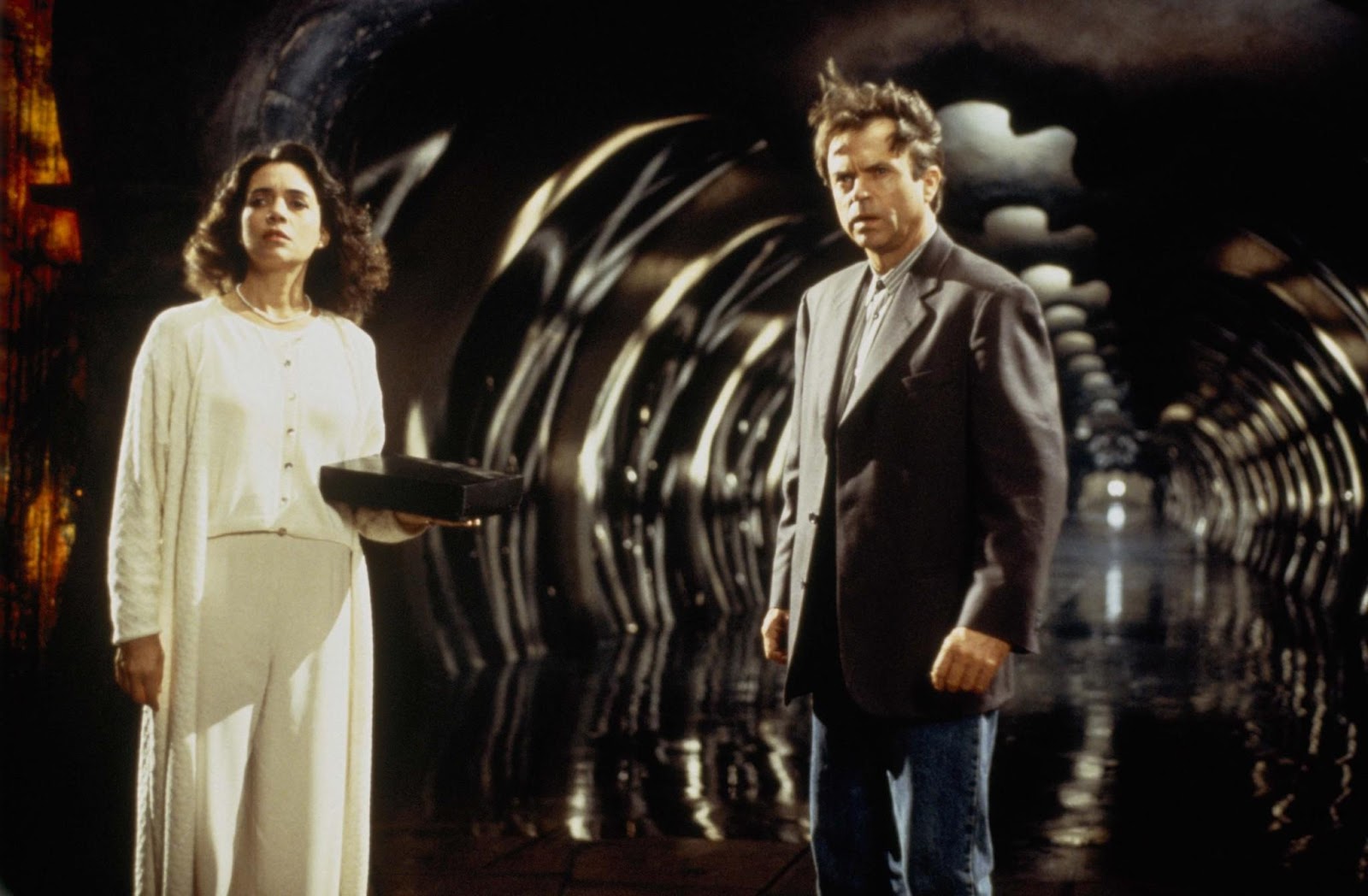
Efficient, and skeptical, freelance insurance investigator John Trent (Sam Neill) is hired by Arcane Publishing director Jackson Harglow (Charlton Heston) to investigate the dissappearence of its star author, horror writer Sutter Cane (Jürgen Prochnow) - and more importantly, recover the manuscript for Cane's final novel. Trent is partnered with Cane's editor, Linda Styles (Julie Carmen), who  explains that Cane's stories have been known to cause disorientation, memory loss and paranoia in "less stable readers". Convinced that the disappearance is a publicity stunt, Trent notices red lines on Cane's book's covers which, when aligned properly, form the outline of New Hampshire and mark a location alluded to be Hobb's End, the fictional setting for many of Cane's works. As Trent and Styles travel to New England, Styles experiences bizarre phenomena during the late-night drive before inexplicably arriving in Hobb's End, suddenly in broad daylight. Trent and Styles search the small town, encountering people and landmarks described as fictional in Cane's novels, especially the Black Church on the outskirts of town. After witnessing the townspeople attacked by a pack of vicious dogs outside the church, Trent confronts Styles, who admits that Arcane Publishing's claim was a stunt to promote Cane's book, but the time distortion and exact replica of Hobb's End were not part of the plan, suggesting that somehow Cane's books are becoming reality. Later, Styles confronts Cane at the Black Church. Cane exposes her to his final novel, In The Mouth of Madness, which drives her insane. Meanwhile, Trent repeatedly tries to leave Hobb's End, but keeps getting teleported back to the center of town, and evetually crashes his car. Trent wakes up in the Black Church, where Cane explains that the public's belief in his stories has freed an ancient race of monstrous beings, the Old Ones, which will reclaim the Earth. Cane then further reveals that Trent is merely one of his characters, who must follow Cane's plot and return the manuscript of In The Mouth of Madness to Arcane Publishing, furthering the end of humanity!

John Trent: [speaking with a psychiatrist] You're waiting to hear about my 'them', aren't you?
Dr. Wrenn: Your what?
John Trent: My 'them'. Every paranoid schizophrenic has one; a 'them', a 'they', an 'it'. And you want to hear about my 'them', don't you?
Dr. Wrenn: I want to know how you got here.
John Trent: Things are turning to shit out there, aren't they?
Top:   Skeptic insurance investigator John Trent (Sam Neill) joins forces with book editor Linda Styles (Julie Carmen) to find reclusive horror author, Sutter Cane (Jürgen Prochnow) (Above)


Michael De Luca first wrote the script in the late 1980's. Although his character Sutter Cane might appear to be representative of author Stephen King, De Luca more likely based the character on H. P. Lovecraft, with Hobb's End based more on Lovecraft's Arkham rather than King's Castle Rock. The plot of the film also more closely resembles something Lovecraft might have written, focusing on the effects that horrific occurrences have on one's sanity, rather than on the external horrors that most of King's writings lean towards. Even the title, In the Mouth of Madness, appears to be an homage to Lovecraft and his story, At the Mountains of Madness. Also, references to the "Old Ones" by Sutter Cane, along with certain representations of monsters printed on his books and latter brought to life, are allusions to The Cthulhu Mythos - a series of stories by H.P. Lovecraft and continued by other writers into modern times (in this sense, one could consider In the Mouth of Madness Carpenter's own contribution to The Cthulhu Mythos). 

One of the first directors he offered it to was John Carpenter, who initially passed on the project. New Line Cinema later announced production in 1989 with director Tony Randel attached to direct (and later Mary Lambert when Randel dropped out). Production stalled however, and three years later Carpenter returned to the project, with filming taking place from August to October 1993, in Ontario, Canada. The exterior of the Black Church seen in Hobb's End is actually the Cathedral of the Transfiguration, a Slovak Byzantine Rite Roman Catholic former cathedral located in Markham (outside Ontario). The building used as the mental institution at the beginning of the film is actually a water filtration plant in the Beaches area of Toronto.

John Trent: [speaking with a psychiatrist] Every species can smell its own extinction. The last ones left won't have a pretty time with it. In ten years, maybe less, the human race will just be a bedtime story for their children. A myth, nothing more.
Above:   Director John Carpenter on set


The dozens of monsters featured towards the end of the film were a combination of men in suits, animatronics and a full-sized "wall" of creatures. It took over thirty people to operate the monsters. At one point during filming of the "Wall of Monsters" sequence, the Wall of Monsters ran over Greg Nicotero's foot! The effect of Julie Carmen spinning her head around was done by having a contortionist stunt-double wear an up-side down prosthetic mask of Carmen's face. Since the stunt double couldn't see, the filmmaker had to guide her on where to go by sound. The demonic Mrs. Pickman creature was shot as a miniature (originally it was a man in a suit prosthetic, but Carpenter didn't find it convincing enough). When Jürgen Prochnow lets the monsters from the other side into our world, originally in the script the entire town was sucked into the other side. When this proved to be too costly, an effects artist over at Industrial Light and Magic recommended that instead he "tears" himself apart like paper.

Released in December 1994 in Italy, before its February release in the US, In the Mouth of Madness grossed a disappointing $3.5 million in its opening weekend, and earning only $9 million at the box office during its US theatrical run. Critics were mostly divided, offering mostly mixed reviews. Kevin Thomas from The Los Angeles Times wrote, "A thinking person's horror picture that dares to be as cerebral as it is visceral", while Roger Ebert (writing for the Chicago Sun-Times) noted, "One wonders how In the Mouth of Madness might have turned out if the script had contained even a little more wit and ambition." 


ROTTEN TOMATOES SCORE:   9%

___________________________________


Wednesday, 1 February 2017


ON THIS DAY IN HORROR - February 1st
"SUSPIRIA" released in Italy in 1977


A newcomer to a fancy ballet academy gradually comes to realize that the school is a front for something far more sinister and supernatural amidst a series of grisly murders, in Dario Argento's Suspiria!


Don't miss out on future blogs, trailers, and clips IHdb has coming up
by Following IHdb's Facebook page above


Suzy Bannion (Jessica Harper) travels to Germany to perfect her ballet skills at the prestigious Tanz Dance Academy. Arriving in the pouring rain, Suzy is refused admission after another woman, Pat (Eva Axén) is seen fleeing the school, calling out words that Suzy can barely make out in the rain. That night Pat is brutally murdered in her friend's apartment. The next morning, Suzy is finally admitted by  Madame Blanc (Joan Bennett), the vice-directress, and Miss Tanner (Alida Valli), one of the instructors. As the weeks go by, Suzy witnesses many strange things; she becomes mysteriously ill and is to be "medicated" with a glass of wine daily; the school becomes infested with thousands of maggots; and Daniel (Flavio Bucci), the blind pianist, is killed by his own guide dog. When Suzy's only friend at the academy, Sara (Stefania Casini), also abruptly "disappears" from the academy - in fact, Suzy has also been murdered by the dark figure that killed Pat - Suzy goes to meet one of Sara's acquaintances, a psychologist, Frank Mandel (Udo Kier), who explains that the academy was founded by Helena Markos, a cruel Greek émigré who was widely believed to be a witch. Finally remembering Pat's curses during the night of her arrival, Suzy returns to the school and finds a hidden passage in Madame Blanc's office and comes face-to-face with Helena Markos' evil coven, still very much alive and who have "plans" for Suzy!


TRIVIA:   The first part of Dario Argento's trilogy of films about the "Three Mothers" - completed with  Inferno (1980) and Mother of Tears (2007).
Top:   American Suzy Bannion (Jessica Harper) comes to Germany to study ballet, but gets more than she bargains for at the sinister Tanz Academy!;
Above:   Suzy befriends Sara (Stefania Casini)


Director/co-writer Dario Argento was originally inspired to make the film from the  stories told by Suspiria co-writer (and Dario's then-girlfriend) Daria Nicolodi's grandmother, who claimed to have fled from a German music academy because witchcraft was being secretly practiced there. Likewise, the film's finale was inspired by a dream that Nicolodi once had; in the dream she said she had encountered an invisible witch and, most bizarrely, there was a panther in the room with her that suddenly exploded. The dream was later written into the film - but it's a porcelain panther that explodes. Dario's first idea was that the ballet school would accommodate young girls not older than 12. However, the studio and producer Salvatore Argento (his father) denied his request because a film this violent involving children would almost certainly be banned. Dario raised the age limit of the girls to 20 but didn't rewrite the script, hence the naiveté of the characters and the occasionally childlike dialogue. He also put all the doorknobs at about the same height as the actress' heads, so they would have to raise their arms in order to open the doors, just like children.

As well as serving as the film's co-writer, Nicolodi was to have starred in the lead role of Suzy Bannion, but the studio insisted that an American actress be cast for the lead to make the film more marketable; actress Jessica Harper, having starred in Brian De Palma's Phantom of the Paradise. Nicolodi does however appear in the film twice - she can be glimpsed in the film's opening sequence that shows Suzy walking through the airport, and she also provides the gravelly voice of Helena Markos. The woman playing Helna Markos is not credited, but according to Harper, she was a 90-year-old ex-hooker who Dario found on the streets of Rome. Argento later cast Joan Bennett as Madame Blanc because of her association with director Fritz Lang, who Dario was a great admirer of, and Alida Valli as Miss Tanner. Stefania Casini, Barbara Magnolfi, Eva Axén and Udo Kier were later added to cast in the roles of Suzy's academy friends Sara and Olga, Pat Hingle, and Sara's psychologist friend Dr Frank Mandel respectively.


TRIVIA:   Suspiria means "to sigh" or "sighed", but also possibly "whispered". It has something to do with the difference in Italian & Spanish language stemming from the Latin root.
 Top and Above:   The Tanz Academy's teachers, Miss Tanner (Alida Valli) and Madame Blanc (Joan Bennett)


Harper later stated that many of the actors spoke different languages during shooting, mostly Italian and German, and it would make communicating difficult at times. However, since the film would be dubbed into English for American release, it was deemed not to be an issue during filming. In fact, since the film was going to be dubbed after principal photography, sound was rarely recorded during shooting. Harper added that it was strange to her to be in the middle of shooting a scene and hearing the background sound of a stagehand hammering away on another set in the studio. Udo Keir had a similar experience on set; since his appearance was rushed in the production schedule, Keir had little time to read the complete script. And so during his scene Harper, a crew person lay on the ground (behind the stone bench where he was sitting) and was telling him his lines as he spoke them to her!

Suspiria is noteworthy for several stylistic flourishes that have become Argento trademarks; the film was made with anamorphic lenses, the production design and cinematography emphasize vivid primary colors, particularly red, creating a deliberately unrealistic, nightmarish setting, emphasized by the use of imbibition Technicolor prints. The imbibition process, used for The Wizard of Oz and Gone with the Wind, is much more vivid in its color rendition than emulsion-based release prints, therefore enhancing the nightmarish quality of the film and was one of the final feature films to be processed in Technicolor.  


Above:   Director Dario Argento with "Helena Markos"


Released on February 1st in Italy (a full six months before its US release) Suspiria was huge commercial and critical success. Dave Kehr of the Chicago Reader gave a positive review, claiming that "Argento works so hard for his effects—throwing around shock cuts, colored lights and peculiar camera angles—that it would be impolite not to be a little frightened". Janet Maslin of The New York Times wrote a mixed review, saying the film had "slender charms, though they will most assuredly be lost on viewers who are squeamish", while critical consensus on the review aggregator site Rotten Tomatoes reads, "The blood pours freely in Argento's classic Suspiria, a giallo horror as grandiose and glossy as it is gory".

It was announced through MTV in 2008 that a remake of Suspiria was in production, to be directed by David Gordon Green, who directed films such as Undertow and Pineapple Express. As with many remakes of cult films, the announcement was met with hostility by some, including Argento himself. After a period of no news in which it was thought that the remake attempt had failed, until Green stated in August 2011 that he was again trying to remake the film. However, after another 3-years of development and legal complications, Green left the project. Finally in September 2015, filmmaker Luca Guadagnino was announced as new director at the 72nd Venice Film Festival, and in October 2016, it was announced that Chloe Grace Moretz would co-star in the remake, alongside Dakota Johnson, and Tilda Swinton. The film began shooting in Italy in late 2016, with actresses Swinton, Moretz, and Mia Goth being seen while filming in Varese, with additional filming expected to take place in Berlin in early 2017.


ROTTEN TOMATOES SCORE:   93%

_____________________________________


Tuesday, 31 January 2017


ON THIS DAY IN HORROR - January 31st
"FINAL DESTINATION 2" released in 2003


When a young woman has a violent premonition of a highway pileup, she blocks the freeway which keeps her and a few others meant to die, safe...Or are they? When the survivors mysteriously start dying, it's up to her to try and find a way to stop Death's design before she's next, in David R. Ellis' Final Destination 2


Don't miss out on future blogs, trailers, and clips IHdb has coming up
by Following IHdb's Facebook page above


One year after the tragic events of Flight 180, college student Kimberly Corman (A.J. Cook) is heading to Daytona Beach, Florida for spring break with her friends, Shaina McKlank (Sarah Carter), Dano Estevez (Alex Rae), and Frankie Whitman (Shaun Sipos). En route, Kimberly has a premonition of logs falling off a semi, causing a massive car crash that kills everyone involved. She stalls her car on the entrance ramp, preventing several people from entering the highway, including Lottery winner Evan Lewis (David Paetkau); widow Nora Carpenter (Lynda Boyd) and her fifteen-year-old son Tim (James Kirk); businesswoman Kat Jennings (Keegan Connor Tracy); stoner Rory Peters (Jonathan Cherry); pregnant Isabella Hudson (Justina Machado); high school teacher Eugene Dix (T.C. Carson); and Deputy Marshal Thomas Burke (Michael Landes). While Thomas questions Kimberly, the pileup occurs just Kimberly foresaw. Shaina, Dano and Frankie are killed by a speeding truck, but Kimberly is saved by Thomas. The survivors are brought to the police station, where they learn about the curse of Flight 180, and later, a chain reaction causes a fire in Evan's apartment which he barely escapes; but when Evan slips the escape ladder falls and impales his eye. Kimberly starts to wonder if the flight 180 incident and the events after weren't just a coincidence. Her only hope lies in Clear Rivers, the sole survivor of flight 180, has been living life in a mental hospital after the bizarre events that lead to the deaths of her friends. But can she help the survivors cheat death one more time?


Clear Rivers: Look, we drove a long way to get here, so if you happen to know how to stop Death, it would be really great if you told us.
William Bludworth: You can't cheat Death. There are no escapes.
Clear Rivers: Bullshit! You told me Death has a distinct design. But Alex and I cheated Death, not once but dozens of times. The design is flawed, it can be beaten.
William Bludworth: Such fire in you now. People are always most alive just before they die. Don't you think?
[rips off Evan's nipple piercing with a pair of pliers and begins to whistle as he cremates Evan's body]
Top:   (R-L) Kimberley (A.J. Cook), Clear (Ali Later), and Thomas (Michael Landes) search for a way to beat Death's design;
Above:   Their search leads them inevitably back to mortician William Bludworth (Tony Todd) who offers them a cryptic solution


Following the huge success of Final Destination (2000), New Line Cinema's then-President of Production Toby Emmerich approached writer Jeffrey Reddick - who had originally conceived of Final Destination as a spec script for an X-Files episode - to write the sequel. Unfortunately, the first films respective director and producer (and co-writers) James Wong and Glenn Morgan weren't available for production of the sequel, as they had signed to their own individual directorial projects; The One (for Wong) and and the remake Willard (for Morgan). Instead, New Line hired second unit director and stunt coordinator David R. Ellis as director, with writing partners Eric Bress and J. Mackye Gruber coming onboard to write the later drafts of the screenplay. Warren Zide and Craig Perry also returned and helped on financing/producing the film.

Originally, Devon Sawa was to reprise his role of Alex Browning for the first film, but a dispute concerning his contract with New Line Cinema could not be settled (so in the movie, it is implied by a newspaper clipping that his character Alex was killed off by a falling brick to the head, as the reason for his character not returning). Despite Sawa's absence, Ali Larter returned to reprise her role as Clear Rivers, with Tony Todd also coming back as the devillish mortician William Bludworth. Canadian actress A.J. Cook was cast as heroine Kimberley Corman after impressing Ellis and Perry by her sensitivity and vulnerability in her audition, and was hired instantly. Ellis described her role as "a girl who can have some fun cause they're going on a trip and they're gonna have a good time, yet someone who can stand up to Clear, to come and challenge Clear on a race, and to bother with Clear."

Newcomers to the cast included many television actors; former Living Single star T. C. Carson (as Eugene Dix), Blackwoods actress Keegan Connor Tracy (playing Kat Jennings), Justina Machado from Six Feet Under (as the pregnant Isabelle), and Michael Landes -  who appeared in the TV series Lois & Clark: The New Adventures of Superman - as the heroic Deputy Thomas Burke. Rounding out the cast of the "survivors" were Lynda Boyd, James Kirk, and David Paetkau, as Niora and Tim Carpenter and gambler/lottery winner Evan Lewis respectively. Debut actors Sarah Carter, Alejandro Rae, and Shaun Sipos were hired as Kimberly's friends Shaina McKlank, Dano Estevez, and Frankie Whitman correspondingly.


Above:   Tim meets an unexpected and gruesome end!


Like the first Final Destination, the sequel waas filmed on location in and around Vancouver Island, British Columbia. The Plaza of Nations was used as a stand-in for Ellis Medical Complex - and the site of Tim's death - while the farm and lake scenes were filmed in Campbell River and Okanagan Lake respectively, though it is depicted in Greenwood Lake, New York. "We shot part of it at the lake where it was 37° cold, which is beyond an ice cream headache. And the second stuff we shot in a big huge tank where we filmed all the underwater sequence, that was in a 93° pool," Landes later clarified (interestingly, Cook and Landes performed their own stunts in both sequences). For the film's opening sequence, British Columbia Highway 19 was utilized as Route 23.


Montage of Death; In the first image, a wide-angle view of Campbell River is shot for background use in the final result. In the second image, a lifecast of Cherry is positioned against a green screen and severed in pieces. In the third image, the first and second image are composited to be presented among the continuity of the film.

Digital Domains Visual Effects Supervisor Jason Crosby pointed out that their studio was mainly selected for the highway sequence after the crew realized real logs only bounced about an inch off the road when dropped from a logging truck. "They were concerned about how they would make the shot happen, not knowing if CG would work. The timing was great because we had just finished a test shot of our CG logs bouncing on the freeway. We sent a tape to Vancouver and after seeing it the crew was convinced that any of the log shots could be done with CG," Crosby indicated. In spite of this, there are no CG cars incorporated in the actual film.


TRIVIA:   Beginning his career as a stuntman, David R. Ellis was probably most remembered for his stunt work in Brian De Palms's Scarface (1983).
Top:   Director David R. Ellis;
Above:   Ellis on set with Ali Larter and A.J. Cook


Final Destination 2 premiered in 2,834 theaters across the United States and Canada on January 31, 2003, earning $16,017,141 in its opening weekend (placing #2 in the United States box office behind the spy thriller, The Recruit). Ultimately, the movie earned nearly $47 million the US/Canada and another $43 million worldwide, for a total gross over $90 million ($22 million less than it's predecessor).

Analogous to its forerunner, the film received generally mixed reviews from critics, with most negative evaluations condemning the film's plot, acting, and screenplay. Roger Ebert of Chicago Sun-Times groused that "perhaps movies are like history, and repeat themselves, first as tragedy, then as farce." Claudia Puig of USA Today wrote on how that "there is an audience for a movie in which innocent people suffer hideous accidental deaths is troubling enough, but a group of creative people chose to direct their energies on this repulsive spectacle [which] simply provokes disgust." However, A. O. Scott of The New York Times imparted "it's not as cheekily knowing as the Scream movies or as trashily Grand Guignol as the Evil Dead franchise, but like those pictures it recognizes the close relationship between fright and laughter, and dispenses both with a free, unpretentious hand",  whereas Sheila Norman-Culp of The Atlanta Journal-Constitution proclaimed that "what Final Destination did for the fear of flying, Final Destination 2 does for the fear of driving."

Three years later, James Wong and Glenn Morgan would return to the series to write/produce/direct Final Destination 3, this time starring Mary Elizabeth Winstead, Ryan Merriman, and Amanda Crew. Final Destination 3 was another  financially successful film in the franchise with a worldwide gross of nearly $120 million. Although Destination 3 was intended to be filmed in 3-D, it wasn't until Final Destination 4 (with David R. Ellis returning to direct) that technology had advanced to the stage that shooting in 3-D was viable (with most of the equipment and technical crew fresh of James Cameron's 3-D epic Avatar). Even though FD4 was billed as the "final" film the series (hence it's alternate title of The Final Destination), New Line Cinema again brought the series back with 2011's Final Destination 5, this time directed by Avatar's 2nd Unit Director, Steven Quale. While FD5 is the second highest grossing film in the franchise, it was however the most critically acclaimed movie in the series, with a Rotten Tomatoes score of 61%.


ROTTEN TOMATOES SCORE:   38%

____________________________________


Monday, 30 January 2017


ON THIS DAY IN HORROR - January 30th
"THE UNINVITED" released in 2009


Anna Ivers (Emily Browning) returns home to her sister Alex (Arielle Kebbel) after a stint in a mental hospital, though her recovery is jeopardized thanks to her cruel stepmother, Rachel (Elizabeth Banks), in The Guard Brothers adaptation of the K-Horror chiller A Tale of Two Sisters - The Uninvited!


Don't miss out on future blogs, trailers, and clips IHdb has coming up
by Following IHdb's Facebook page above


After the death of her ill mother in a fire, the young teenager Anna (Browning)tries to commit suicide and is sent to a mental institution for treatment. Ten months later, Anna still cannot remember what had happened on the night her mother died, but her psychiatric Dr. Silberling (Dean Paul Gibson), however, discharges her telling that she has resolved her issues. Her father and successful writer, Steven (David Strathairn), brings her back home in an isolated mansion nearby the coast. Anna finds that her mother's former nurse, Rachel Summers (Banks), is her stepmother now. Anna meets her beloved sister, Alex (Kebbel), swimming in the sea and later discovers that Steven has not delivered the letters and CDs that Alex had sent to her. As time moves on, Anna is haunted by ghosts and increasingly believes that Rachel killed her mother. Alex and Anna decide to look for evidence to prove that Rachel is the murderer and Anna discovers the truth about the fire in the boat house!


Anna: [going through Rachael's stuff] Geez when are they bringing in the stripper pole.
Alex: I know, she's like a crack-whore without the dignity.
Top:   Anna and Alex's cruel new stepmother, Rachel (Elizabeth Banks);
Above:   Sisters Alex (Arielle Kebbel) and Anna (Emily Browning) slowly become convinced Rachel had something to do with their mother's death


Since first starting the cycle of Asian horror film adaptations, producers Walter F. Parkes and Laurie MacDonald searched for a project they felt was as ingeniously conceived and executed as The Ring - which they produced, along with it's sequel The Ring Two in 2005 - and finally found it when producer Roy Lee brought the Korean film A Tale of Two Sisters to their attention. By that time, A Tale of Two Sisters had been playing in US theaters and directors Tom and Charlie Guard had acquired the English language remake rights. By June 2006, DreamWorks announced that a deal had been set up for the US version of A Tale of Two Sisters, with Parkes, MacDonald and Lee producing, The Guard Brothers directing, with a script by Craig Rosenberg, Doug Miro and Carlo Bernard.

Emily Browning was hired to portray the lead Anna Ivers, after originally auditioning for the role of Alex (the role of Alex would eventually go to actress Arielle Kebbel, making this her second appearance in an Asian horror remake, after co-starring in The Grudge 2). David Strathairn plays the concerned father of the two girls, while Elizabeth Banks was cast as the cruel stepmother Rachel. Banks reportedly based her character Rachel on Rebecca De Mornay in The Hand That Rocks the Cradle, stating, "It was very important to me that every line reading I gave could be interpreted two ways," says Banks of her role, "So that when you go back through the movie you can see that."


TRIVIA:   A variation of clever camera angles and forced perspective helped maintain the illusion that Elizabeth Banks was several inches taller than Emily Browning, who, in reality, is only two inches shorter.
Top and Above:   Anna starts to see horrifying visions of her dead mother (Maya Massar) as the very real body of her ex-boyfriend Matt (Jesse Moss) is found broken in half!


Although the film is set in Maine, it was shot in Vancouver, British Columbia with most of the film being shot at one location; a waterfront property on British Columbia's Bowen Island, a short ferry ride west from mainland Vancouver. Porucer Parkes later remarked on the shooting location, "We were lucky to find in Canada a place that seemed as if it had been built for our movie. It was perfectly evocative and suggestive of a family that is both welcoming and forbidding. The fact that the house was within 30 miles of Vancouver was a greater plus than the minus of having to get everyone on boats to get them over there; water taxis and ferries are a way of life up there. In fact, I don’t remember ever having a more pleasant time on a location. Getting onto a boat and having a cup of coffee and then going up the little pier and the stairs we built, it focused us. We were isolated with one thing on our minds, which was making this movie. It was great."

Released on January 30th, 2009, The Uninvited was a moderate hit, grossing over $40 million at the box office, but reviews were mostly negative. Critic Jason Di Rosso from ABC Radio National's Movietime wrote the film is "punctuated by a crescendo of unoriginal set pieces designed to make you jump in your seat, but more likely to leave you groaning", while Kim Newman from Empire Magazine reviewed it was a "Poor remake of the Korean thriller." There were some who were more positive in the reviews, such as Nigel Floyd of Time Out who wrote, "As in the original, the film slyly manipulates the audience's perspective, and a brilliantly filmed climactic 'reveal' marks this British duo as a pair to watch." and CinePassion's Fernando F. Croce summed up, "As far as PG-13 Americanizations of Asian shockers go, it's about 70 percent passable". Ali Gray (TheShiznit.co.uk) summed up, "It's not original, it's not especially clever and the twist won't make you want to watch it again, but hey - at least it wasn't The Unborn!"


ROTTEN TOMATOES SCORE:   32%

______________________________________


ON THIS DAY IN HORROR - January 30th
"THE SILENT SCREAM" released in 1980


Four college students - Scotty (Rebecca Balding), Jack (Steve Doubet), Peter (John Widelock) and Doris (Juli Andelman) - who are unable to find on-campus housing, take up residence in Mrs Engels's (Yvonne De Carlo) hilltop mansion, where she lives with her strange son, Mason (Brad Rearden), and her daughter, Victoria (Barbara Steele); whom Mrs Engels secretly keeps hidden in the attic after a botched lobotomy left her mute and homicidal. After one of the students is found dead, a police investigation led by Lt. Sandy McGiver (Cameron Mitchell) uncovers the history of the mansion and its owners, as the remaining students are hunted by an unseen killer, in Denny Harris' debut feature The Silent Scream!


Don't miss out on future blogs, trailers, and clips IHdb has coming up
by Following IHdb's Facebook page above


Filmmaker Denny Harris was already a successful TV commercial director with his own self-named studio before he embarked on making his first feature horror film. Using his own staff, facilities, and money - reportedly Harris spent over $450,000 - the film was shot in the summer of 1977. Starring Rebecca Balding, the actress had originally turned the project down to star in the TV series Lou Grant (1977); however, after the third episode was shot, Balding was "let go" from the series and then accepted the part in the film. Joining the her in the cast were newcomers Juli Andelman, John Widelock, and Steve Doubet (Doubet also recruited his girlfriend -and future wife - Tina Tyler to play the role of the young Victoria).
 
The Engels house location was actually a Highland Park, Los Angeles home called The Smith Estate, and it was previously known as the Merrye house in the cult classic Spider Baby (1967) (in both instances the house was chosen because it stands upon a hill, which made it easier to shoot wide angles and obscure the view of the neighboring homes in order to achieve a sense that the house is very isolated). In order to shoot all the exteriors on the Engels house in a single day, the filmmakers mapped out where scenes would appear in the film and they moved the camera around the house throughout the day, taking full advantage of the sunlight.


TRIVIA:   Steve Doubet did vocal exercises before each take. "It's like he had pneumonia and was coughing up phlegm," recalled co-star Rebecca Balding.
Top and Above:   College students (L-R) Peter (John Widelock), Doris (Juli Andelman), Scotty (Rebecca Balding) and Jack (Steve Doubet) decide to live in the strange hilltop mansion.


Over the course of filming, three different locations were used for the laundry room scene: a real basement, a small basement set and a smaller set for the dark corner next to the furnace and hidden staircase. The hidden staircase from the basement to the attic was a single set. To achieve the illusion that it snaked up multiple stories, the lighting, cobwebs and furnace pipes were switched, with narrower pipes on the upper floors. A scene was scripted in which the killer wraps a rope around Doris's corpse and drags her up the hidden staircase, which explains how she got into the attic. The scene was deemed too technical and time consuming to properly achieve, so it was never filmed. Apparently, Andelman did not like playing background as Doris' corpse in the closet after her character was killed, so she intentionally moved around and ruined takes. Eventually the filmmakers decided to have another character cover her body with a sheet so the actress would not have to be present during the filming of those scenes.

With filming wrapped, Harris began post-production, but soon realized that the first cut of the original version was completely unrelease-able! Harris turned to screenwriters Jim and Ken Wheat to help improve the story, but they had the radical idea to re-shoot the bulk of the film with name-actors to replace certain characters from the original. Yvonne De Carlo, Barbara Steele, Cameron Mitchell, and Avery Schreiber were soon brought in, for an extremely limited schedule. Mitchell and Schreiber were hired to work on the film for two days, with most of their scenes covered with two cameras (unbeknownst to Mitchell's agent, the actor returned for one afternoon to film a few pick-up shots and was paid $500 cash). Barbara Steele completed her scenes in four days. Being her only film appearance in the 80's, Steele stated she accepted the role because it afforded her a rare opportunity to play a mute character.   


TRIVIA:   Reportedly, Rebecca Balding claimed she had never heard of Barbara Steele until the actress was hired for the reshoot.
Top and Above:   Mrs Engels's "odd" children, Mason (Brad Rearden), and Victoria (Barbara Steele).


The actors and actresses who played the college students were brought back for re-shoots in March 1978. Because the name actors had a short shooting schedule and additional coverage was needed, co-writer and producer Ken Wheat appears as a double for both De Carlo and Steele, while his brother, co-writer/producer Jim Wheat, appears as Avery Schreiber's double. Jim's girlfriend/future wife also doubled for De Carlo's character in various shots and Ken's girlfriend/future wife doubled Steele. Shot in the days before video playback, the Wheat brothers had to bring a Moviola to the set to try to match shots that would inter-cut with existing footage which was filmed 8 months earlier. In the end, only 12 minutes of footage from the original version was retained in the final finished film!  

Released theatrically by American Cinema Releasing, The Silent Scream had an extremely limited run in Victor, Texas, before a wider release on January 30th, 1980, beginning in Bismarck, North Dakota. The Silent Scream also screened regionally throughout the 1980 and eventually grossed over $15 million at the box office - making Harris' debut a huge financial success. Due to it's limited exposure, not many reviews have been able to be found. However, in 2012 Jeremy Heilman of MovieMartyr.com wrote, "The Silent Scream is something less than a classic of its genre, but still manages to be worth a look for aficionados of the era's horror films." 


ROTTEN TOMATOES SCORE:   31%

__________________________________