Friday, 4 November 2016


ON THIS DAY IN HORROR - November 4th
"THEY LIVE" released in 1988


Don't miss out on future blogs, trailers, and clips IHdb has coming up
by Following IHdb's Facebook page above


Unemployed drifter "John Nada" (Roddy Piper) finds construction work in Los Angeles and befriends fellow construction worker Frank Armitage (Keith David), who leads him to a local shantytown soup kitchen. There, Nada encounters strange activity around the church: a blind preacher (Raymond St. Jacques) loudly chastising others to wake up, a police helicopter scouts them overhead, and a Drifter (George Buck Flower) complains that his TV signal is continually interrupted by a man warning everyone about those in power. Nada discovers the nearby church is a front, and is filled with scientific equipment and cardboard boxes. That night, the police attack and bulldoze the shantytown. Nada returns in the morning to find the church empty, but with the hidden boxes still in the wall. He takes one of the boxes and in an alley, he opens the box and finds it filled with sunglasses, and quickly discovers they have unique properties; they reduce the colors of the world around him to black and white and allow him to see that media and advertising hide omnipresent subliminal commands to obey, consume, reproduce, and conform. They also make clear that many people in positions of wealth and power are actually humanoid aliens with skull-like faces!


[Nada enters a bank, holding a shotgun]
Nada: I have come here to chew bubblegum and kick ass... and I'm all out of bubblegum!
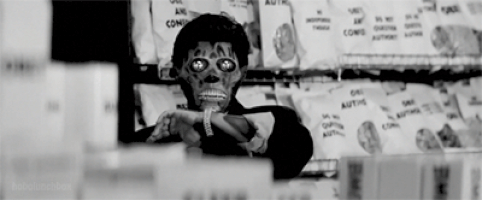
Top and Above:   Drifter, Nada (Roddy Piper) discovers his peculiar sunglasses reveal that aliens are among us!


In a grocery store, Nada confronts an alien woman who then speaks into her wristwatch, notifying others about him, but Nada manages to kill the aliens pursuing and later goes on a shooting spree, killing several aliens that he encounters in a nearby bank. Pursued by a small, flying saucer-like alien surveillance drone, Nada takes a Cable 54 assistant director named Holly Thompson (Meg Foster) hostage. After trying to convince her of the truth, Nada is tricked and pushed down the steep hill underneath Holly's hillside home. Nada returns to the alley where he finds the garbage can that held the other glasses, and encounters Frank. Nada engages in an extended street fight with Frank, trying to force him to put on a pair of sunglasses. Finally after gaining the upper hand, Nada places the glasses on Frank who now understands. The two rent a hotel room to discuss their predicament, and later meet with Gilbert (Peter Jason), a member of the shantytown, who notifies them about a secret meeting with other activists.

At the meeting, Nada and Frank are given special contact lenses to replace their sunglasses and they learn from the bearded man's broadcast that the aliens control Earth as their third world, depleting its resources and causing global warming before moving on to other planets. The aliens use a subliminal signal broadcast into people's brains to camouflage themselves, which they believe if it is destroyed, will allow everyone on Earth to see their true form. Without warning, the police suddenly attack the meeting, killing everyone while Nada and Frank manage to fight their way out. After being cornered in an alley, Frank accidentally opens a temporary portal by throwing the watch, through which the two jump into a network of underground passages.

The two find the aliens in a grand hall celebrating with their elite human collaborators, including the homeless Drifter from earlier, now a well-dressed collaborator, who believes Nada and Frank to be collaborators as well. Playing along, the Drifter takes them on a tour of the passages, and Nada eventually discovers the Cable 54 station's satellite dish is the source of the aliens signal. Nada and Frank then launch their attack, fighting there way to roof in order to destroy the dish in a last desperate struggle free the people of Earth from virtual slavery!


[Nada tries to convince Frank to wear the sunglasses]
Nada: I'm giving you a choice: either put on these glasses or start eatin' that trash can.
Frank: Not this year!
Top and Above:   Nada manages to convince Frank (David Keith) of the truth and the two pair up to save the world!


The idea for They Live came from a short story called "Eight O'Clock in the Morning" by Ray Nelson, originally published in The Magazine of Fantasy and Science Fiction in November 1963, involving an alien invasion in the tradition of Invasion of the Body Snatchers, which Nelson, along with artist Bill Wray, adapted into a story called "Nada" in April, 1986. Carpenter acquired the film rights to both the comic book and short story and wrote the screenplay, using Nelson's story as a basis for the film's structure, and added his own political criticism of the ever-increasing commercialization of the 1980s under Ronald Reagan (usually referred to as "Reaganomics" or "Reaganism"). Carpenter later remarked, "I began watching TV again. I quickly realized that everything we see is designed to sell us something... It's all about wanting us to buy something. The only thing they want to do is take our money." To this end, Carpenter thought of sunglasses as being the tool to seeing the truth, which "is seen in black and white. It's as if the aliens have colorized us. That means, of course, that Ted Turner is really a monster from outer space." (Turner had received some bad press in the 1980s for colorizing classic black-and-white movies!).

For the aliens, Carpenter wanted them to superficially resemble walking, rotting corpses, rather than the "high-tech" creatures of other science fiction films. He decided that since these beings were corrupting humanity, they themselves should resemble corruptions of human beings. Because the screenplay was the product of so many sources - a short story, a comic book, and input from cast and crew - Carpenter decided to use the pseudonym "Frank Armitage", an allusion to one of the filmmaker's favorite writers, H. P. Lovecraft (Henry Armitage is a character in Lovecraft's The Dunwich Horror). Alive Films, the studio who financed Carpenter's previous picture, Prince of Darkness, produced They Live, once again granting Carpenter the "final cut".


Nada: You see, I take these glasses off, she looks like a regular person, doesn't she? Put 'em back on...
[puts them back on]
Nada: ...formaldehyde-face!
Top:   Holly Thompson (Meg Foster) reveals herself as a alien collaborator and tries to stop Nada from destroying the source of the signal that disguises the aliens true form;
Above:   With the signal now gone, this Woman has a shocking surprise waiting for her!


Carpenter originally wrote the role of Nada for frequent collaborator Kurt Russell to play, but in early in development decided to cast someone else as Russell had already starred in three of his previous films; Escape from New York (1981), The Thing (1982) and Big Trouble in Little China (1986). Wanting a truly "rugged individual" to play the lead, Carpenter approached wrestler "Rowdy" Roddy Piper for the role after meeting him at WrestleMania III (1987). Although Carpenter decided against casting Russell, They Live has numerous other actors who the director had worked with before, including David Keith (The Thing) as Frank, and Peter Jason (Prince of Darkness) as Gilbert. Actress Meg Foster was cast as femme fatale Holly Thompson after Carpenter had seen her performance in the Canadian film Ticket to Heaven (1981), while the alien featured in the last shot of the movie was portrayed by stunt coordinator Jeff Imada.

They Live began production in March 1988, principally on location in downtown L.A., with a budget only slightly greater than $3 million. The big fight sequence between Nada and Frank was originally designed, rehearsed and choreographed in the back-yard of Carpenter's production office. The fight was only supposed to last twenty seconds, but Piper and David decided to fight it out for real, only faking the hits to the face and groin, rehearsing the fight for three weeks. Carpenter was so impressed he kept the entire five minutes and twenty seconds scene intact. Carpenter recalls that, "It was an incredibly brutal and funny fight, along the lines of the slugfest between John Wayne and Victor McLaglen in The Quiet Man."


TRIVIA:   Roddy Piper, being a married man at the time of filming, refused to take his wedding band off. That's why in several scenes you can see a wedding ring on.
Top:   Director John Carpenter on set with a few of the "alien" cast;
Above:   Carpenter on set with Roddy Piper


They Live opened on November 4, 1988 and debuted at #1 at the North American box office grossing $4.8 million during its opening weekend, and spent the next two weeks in the top ten - before quickly fizzling out at the box office. Carpenter is on record as attributing the film's initial commercial failure to the hypothesis that those "who go to the movies in vast numbers these days don't want to be enlightened". Nevertheless, They Live received some of the best reviews of Carpenter's career, with the  Chicago Reader's Jonathan Rosenbaum writing, "Carpenter's wit and storytelling craft make this fun and watchable, although the script takes a number of unfortunate shortcuts, and the possibilities inherent in the movie's central conceit are explored only cursorily." Jay Carr, writing for The Boston Globe, said "[O]nce Carpenter delivers his throwback-to-the-'50s visuals, complete with plump little B-movie flying saucers, and makes his point that the rich are fascist fiends, They Live starts running low on imagination and inventiveness", but felt that "as sci-fi horror comedy, They Live, with its wake-up call to the world, is in a class with Terminator and RoboCop, even though its hero doesn't sport bionic biceps".


ROTTEN TOMATOES SCORE:   84%

__________________________________


Thursday, 3 November 2016


ON THIS DAY IN HORROR - November 3rd
"CARRIE" limited released in 1976


Don't miss out on future blogs, trailers, and clips IHdb has coming up
by Following IHdb's Facebook page above


Shy, bullied high school student Carrie White (Sissy Spacek) is initially terrified when she experiences her first period as she showers with other girls after gym class. Unaware of what is happening to her, she panics and pleads for help, but the other girls cruelly respond by pelting her with hygiene products, laughing and chanting "plug it up!" Gym teacher Miss Collins (Betty Buckley) breaks up the commotion and attempts to console Carrie, when a light bulb mysteriously shatters as Carrie reaches the height of her panic.

While walking home that day, other strange phenomenon occur whenever Carrie is angered or frustrated; a boy who teased her is thrown from his bike by an invisible force, and once home, her bedroom is violently shattered after she is abused by her fanatically religious mother, Margaret (Piper Laurie). Later, Carrie’s classmate Sue (Amy Irving) feels guilty for her part in the showers, so she arranges for her boyfriend, handsome and popular Tommy (William Katt), to ask Carrie to the prom. Reluctant at first, Carrie eventually accepts after encouragement from Miss Collins. Meanwhile, another classmate, Chris (Nancy Allen), skips her detention for bullying Carrie, so she is banned from the prom. Swearing vengeance, she recruits her delinquent boyfriend Billy (John Travolta) to play a prank on Carrie. That night, they slaughter pigs from a nearby farm and place a bucket of their blood above the stage at the school’s gymnasium. On the night of the prom, Carrie, having researched her telekinesis, asserts her power and stands up to her mother after she forbids her to go, and Margaret responds by accusing Carrie of being a satanic witch.

At the prom, Carrie finds acceptance among her peers and shares a kiss with Tommy. Chris' bubbly best friend Norma (P.J. Soles) rigs the election and Carrie is crowned Prom Queen. Carrie’s joy is cut short when Chris pulls a rope to dump the pigs' blood on her. Chris and Billy escape through a back door, while the bucket falls on Tommy's head, knocking him unconscious. The blood-soaked Carrie hallucinates that everyone in the gymnasium is laughing at her and soon unleashes telekinetic fury upon the crowd, guilty and innocent alike. The doors slam shut (crushing a pair of students), a high-pressure water hose assaults many people (including Norma, who is knocked unconscious), the principal is electrocuted, and Miss Collins is crushed to death. As the gym catches fire, Carrie calmly walks out and locks the remaining students inside. Chris and Billy attempt to run over Carrie as she walks home, but Carrie causes their car to flip and explode. Now completely insane, Carrie finally returns home to confront her mother, who reveals a devastating revelation of her own!


Mr. Morton: We're all sorry about this incident, Cassie.
Carrie: [voice breaking, shouts] It's Carrie!
[Morton's ashtray, without reason, flips onto the floor, backwards. Miss Collins jumps back in shock]
Top:   Shy, introverted Carrie White (Sissy Spacek);
Above:   Carrie is comforted by gym teacher Miss Collins (Betty Buckley)


Carrie was the first Stephen King novel to be published and the first to be adapted into a feature film. Initially, King was reluctant to send Carrie to a publisher because it sounded (to him) the least marketable of all his manuscripts at the time. But horror was a hot commodity what with successes like The Exorcist (1973) and Rosemary's Baby (1968) so the novel became a sleeper success. The novel was then suggested to filmmaker Brian De Palma by a writer friend of his, and proceeded call his agent to find out if anyone owned the film rights yet. De Palma found out that nobody had yet, but a few studios were interested. The director quickly let it be known that he was very interested in joining the production, and, after the rights were finally purchased by United Artists, was chosen to helm the picture. Lawrence D. Cohen was hired as the screenwriter, and produced the first draft, which had closely followed the novel's intentions, and after a final second draft was submitted, De Palma was allocated $1.6 million to shoot the picture (a relatively small sum, considering the popularity of horror films at the time).

Many young actresses auditioned for the lead role of Carrie White, including Melanie Griffith, Jill Clayburgh, Pamela Sue Martin, Betsy Slade, Glenn Close and Farrah Fawcett (Fawcett ultimately bowed out due to scheduling conflicts with her TV series, Charlie's Angels). Linda Blair was then offered the role, but after appearing in the Exorcist, turned the role down as she feared being typecast.  Sissy Spacek - who was not even considered for the part by the studio - was persuaded by husband, art director Jack Fisk, to audition for the title role, who then talked De Palma into seeing her. Up until that point, De Palma was strongly considering Amy Irving for the role when he agreed to audition Spacek, who showed up to the audition with Vaseline rubbed into her hair and wearing a sailor dress (which her mother had made for her when she was in the seventh grade) with the hem cut off. Impressed with her determination to get the part, De Palma cast Spacek in the lead role and cast Irving as Carrie's friend Sue Snell (interestingly, De Palma cast Irving's real life mother, Priscilla Pointer, to play Sue's screen mother Mrs Snell!). To prepare for her character, Spacek isolated herself from the rest of the ensemble, decorated her dressing room with heavy religious iconography and studied Gustave DorĂ©'s illustrated Bible. She studied "the body language of people being stoned for their sins," starting or ending every scene in one of those positions.


Carrie: [reading from a library book] Telekinesis... thought to be the ability to move... or to cause changes... in objects... by force of the mind...?
Top:   Sue Snell (Amy Irving) starts to feel guilty for tormenting Carrie, and (above) has her boyfriend Tommy (William Katt) ask her to the prom


John Travolta auditioned while on a lunch break filming Welcome Back Kotter, showing up still dressed as Vinnie Barbarino. De Palma, who didn't realize Travolta was one of the stars of the hit TV show, cast him in the role of Billy Nolan. They were soon joined by P. J. Soles (as Norma Watson), William Katt (as Tommy Ross), and Betty Buckley (as Miss Collins). According to Piper Laurie, - who was cast as Carrie's insane, religious mother, Margaret White - she honestly thought her character was too over the top fanatical to be taken seriously, even when De Palma had to take her to the side and personally tell her it was a horror film and not a "black comedy" as she thought it was. Even so, she would constantly burst out into laughter between takes because not only was her characterization and wardrobe laughable in her eyes, but the dialogue itself was humorous for her (to this day, she still refers to and maintains the movie as "a black comedy").

Last to audition was Nancy Allen for the role of the main antagonist, Chris Hargensen. Allen, who was on the verge of leaving Hollywood before landing the part, never realized that her character was going to be so evil until she saw the finished film, she thought - like Laurie - that she and Travolta were playing such self-centered, bickering morons for comic relief. Allen herself would later marry De Palma in 1979 and star in two more De Palma films; Dressed to Kill (1980) and Blow Out (1981), the latter film co-starring again with Travolta.


TRIVIA:    Brian De Palma wanted Betty Buckley to really slap Nancy Allen. Because Allen couldn't get the reaction De Palma wanted, Buckley ended up slapping her as many as thirty times.


Top:   Mean girl Chris (Nancy Allen) swears revenge on Carrie and recruits Norma (P.J. Soles) and (above) her boyfriend Billy (John Travolta)


De Palma began the production on May 17th, 1976, with director of photography Isidore Mankofsky, who was eventually replaced by Mario Tosi after conflict between Mankofsky and De Palma ensued. The White house was filmed in Santa Paula, California and to give the home a Gothic theme, director and producers went to religious shops looking for artifacts to place in the home. A wraparound segment at the beginning and end of the film was scripted and filmed which featured the Whites' home being pummeled by stones that hailed from the sky. The opening scene was filmed as planned, though on film, the tiny pebbles looked more like rain water. And after a mechanical malfunction botched production the night when the model of the Whites' home was set to be destroyed, filmmakers decided to burned it down instead and dropped the scenes with the stones altogether. It's this version that remains in the finished film, although internal scenes remain showing rocks coming through the roof.

The prom scene took over two weeks to shoot and required a total of 35 takes, with Spacek covered in "pig's blood" made from karo syrup and food coloring; although reportedly, Spacek was willing to have real blood dumped on her! However, the bright, hot lights caused the substance to keep drying and sticking to her skin, so, in order to correct this problem, she was hosed down until it became of a gluey consistency. Spacek refused to wash off the fake blood so that the continuity of the movie would not be harmed, even sleeping in the "bloody" clothes for three days of filming. An actual fire hose was used on P. J. Soles (who played Norma), the force of which ruptured her ear drums, and knocked her unconsciousness! Soles was later deaf in that ear for six months after filming. When Carrie's mother meets her demise (she is stabbed multiple times with flying knives), the knives started off in Margaret's body before being pulled out by string. When editing the scene, they played the footage in reverse to achieve the look of the knives flying towards Margaret


[Jim enters a dark abandoned church when he sees writing on the wall]
Writing on a Wall: 'Repent, The End Is Extremely Fucking Nigh'
 Top:   Humiliated by Chris' cruel prank, Carrie unleashes her full powers at the prom;
Above:   Carrie eventually kills Chris and Billy, who earlier escaped the prom massacre

The final scene, in which Sue reaches toward Carrie's grave, was shot backwards to give it a dreamlike quality. This scene was inspired by the final scene in Deliverance (1972). Spacek had insisted on using her own hand in the given scene, so she was positioned under the rocks and gravel. De Palma stated, "Sissy, come on, I'll get a stunt person. What do you want? To be buried in the ground?!" However, Spacek declared, "Brian, I have to do this." De Palma explains that they "had to bury her. Bury her! We had to put her in a box and stick her underneath the ground. Well, I had her husband bury her because I certainly didn't want to bury her. I used to walk around and set up the shot and every once in a while we'd hear Sissy: 'Are we ready yet?' 'Yeah, Sissy, we're going to be ready real soon.'"

Carrie received largely positive reviews when released in 1976, and is still widely regarded as one of the best films of that year. Roger Ebert of the Chicago Sun-Times stated the film was an "absolutely spellbinding horror movie", as well as an "observant human portrait", giving three and a half stars out of four. Pauline Kael of The New Yorker stated that Carrie was "the best scary-funny movie since Jaws – a teasing, terrifying, lyrical shocker". Take One Magazine critic Susan Schenker said she was "angry at the way Carrie manipulated me to the point where my heart was thudding, and embarrassed because the film really works." In addition to being a box office success - earning $14.5 million in theater rentals by January 1978 - Carrie is notable for being one of the few horror films to be nominated for multiple Academy Awards, with Sissy Spacek and Piper Laurie receiving nominations for Best Actress and Best Supporting Actress awards, respectively. Carrie would be De Palma's first successful film at the box office (enabling to later direct and produce such big studio pictures as Scarface (1983), The Untouchables (1987), Carlito's Way (1993), and Mission: Impossible (1996) among many others), and is widely known to be King's personal favorite of all the films adapted from his work.


TRIVIA:   Early on, many of the girls present in the locker room were originally hesitant to appear nude in the film, but after De Palma showed them the nude shots of Spacek, they became more confident
 Top:   Director Brian De Palma on set with Sissy Spacek;
Above:   De Palma filming the prom scenes


In 1999, a loosely related sequel, The Rage: Carrie 2, was released. It also featured another teenager with telekinetic powers who is revealed to have shared a father with Carrie White. In 2002, a television film based on King's novel and starring Angela Bettis in the titular role was released. The film updated the events of the story to modern-day settings and technology while simultaneously attempting to be more faithful to the book's original structure, storyline, and specific events. However, the ending was drastically changed: instead of killing her mother and then herself, the film has Carrie killing her mother, being revived via CPR by Sue Snell and being driven to Florida to hide.  Although Bettis' portrayal of Carrie was highly praised, the film was cited by most critics as inferior to the original.

Playwright Erik Jackson eventually earned the consent of King to mount a new, officially-sanctioned, non-musical production of Carrie, which debuted Off-Broadway in 2006 with female impersonator Sherry Vine in the lead role. Similarly, many other unofficial spoofs have been staged over the years, usually with a gym teacher named "Miss Collins" (as opposed to the novel's "Miss Desjardin" and the musical's "Miss Gardner"), most notably the "parodage" Scarrie the Musical, which hit the Illinois stage in 1998 and was revived in 2005. Then in May 2011, Metro-Goldwyn-Mayer and Screen Gems announced that Carrie would be adapted to film once more. This time the role of Carrie was played by 16-year-old actress Chloë Grace Moretz, with Julianne Moore starring as Carrie's mother Margaret White. Directed by Boys Don't Cry filmmaker Kimberly Peirce, the remake also starred Gabriella Wilde as Sue Snell, with Alex Russell and Broadway actor Ansel Elgort playing Billy Nolan and Tommy Ross, respectively. Portia Doubleday was given the role of Chris Hargensen and Judy Greer was cast as Gym teacher Miss Desjardin. Like previous installments, Carrie (2013) received mixed reviews, but still managed to gross an impressive $85 million at the box office.


ROTTEN TOMATOES SCORE:   93%

________________________________  


Tuesday, 1 November 2016


ON THIS DAY IN HORROR - November 1st
"28 DAYS LATER..." premiered in London in 2002


Don't miss out on future blogs, trailers, and clips IHdb has coming up
by Following IHdb's Facebook page above


In Cambridge, three animal liberation activists break into a medical research laboratory. A scientist in the lab desperately warns them against releasing the captive chimpanzees, which are infected with a highly contagious rage-inducing virus. Ignoring his pleas, the activists release a chimp, which infects a female activist. She then attacks and infects everyone else present.

28 days later, in London, Jim (Cillian Murphy), a bicycle courier, awakens from a coma in St Thomas' Hospital. He finds the entire hospital deserted. He wanders the streets of London, finding it deserted as well, with signs of catastrophe everywhere. Jim enters a church and finds a priest, who turns out to be infected. Jim flees, attracting attention of more infected, but Selena (Naomie Harris) and Mark (Noah Huntley) rescue him. At one of their safehouses, they explain to Jim that while he was in a coma, a virus spread among the populace, resulting in societal collapse. The next day, Selena and Mark accompany Jim to his parents' house in Deptford, where he discovers they committed suicide in bed together. That night, the three are attacked by more infected. Mark is bitten, and Selena viciously kills him. She curtly explains that the virus spreads through blood and saliva and overwhelms its victims in 10 to 20 seconds. Later, the two see some blinking Christmas lights from Balfron Tower, where they discover two more survivors – cab driver Frank (Brendan Gleeson) and his daughter Hannah (Megan Burns) – who allow them to take shelter. The next day, Frank informs them that their supplies – particularly water – are dwindling. He plays them a pre-recorded radio broadcast from a military blockade near Manchester, claiming they have "the answer to infection" and promises to protect any survivors who reach them.

The group board Frank's cab and head to Manchester, bonding with one another throughout the trip. At the deserted blockade, Frank is infected when a drop of blood falls into his eye. He is killed by the arriving soldiers, who take the remaining survivors to a fortified mansion under the command of Major Henry West (Christopher Eccleston). West reveals to Jim that his "answer to infection" entails waiting for the infected to starve to death and luring female survivors into sexual slavery, to repopulate the world. The group attempts to flee, but Jim is captured and chained next to Sergeant Farrell (Stuart McQuarrie), a dissenting soldier. The next day, while being led away by two soldiers to be executed, Jim escapes and lures West and another soldier to the blockade, where Jim kills the latter and leaves West stranded for arriving infected. With time running out, Jim races back to the mansion to save Selena and Hannah from the remaining soldiers, before the horde of infected arrive and overrun the entire estate!


[Jim enters a dark abandoned church when he sees writing on the wall]
Writing on a Wall: 'Repent, The End Is Extremely Fucking Nigh'
Top:   An infected monkey "rescued" by a group of activists starts the spread of the Rage virus;
Above:   Jim (Cillian Murphy) wakes from a coma and wonders the deserted streets of London


After director Danny Boyle and producer Andrew Macdonald filmed an adaptation of Alex Garland's novel The Beach, Garland approached Macdonald about his concept for 28 Days Later. Garland explained, "I said to him that I had an idea for a movie about running zombies. I wrote it and sent it to him and the two of us went backwards and forwards with it for a few drafts... At the point I was working on 28 Days Later I had a lot of zombie movies as well as video games like Resident Evil turning round in my head."

Both Garland and Boyle felt that the notion of the living dead wanting to eat peoples' brains was outdated and one of the original factors behind zombie movies was a fear of nuclear power and its possible effects on people. Garland and Boyle concluded that one of the biggest fears in modern society is fear of disease, especially a viral apocalypse, such as Ebola or Marburg. Garland and Boyle were specifically inspired by such incidents as anthrax and bio-terrorism scares in London and the spread of mad cow disease and foot-and-mouth disease in the UK. The 'design' for the symptoms of Rage was based on Ebola, which is communicable in all primates (including humans), and is transmitted through the blood. Ebola is a hemorrhagic fever which leads to a rash, red eyes and both internal and external bleeding. Indeed, in 28 Days Later: The Aftermath (a graphic novel set between 28 Days Later and 28 Weeks Later (2007), it is explained that the Ebola virus was being used by the scientists as a carrier for the inhibitor which mutated into Rage.

Another aspect of rendering the zombie movie more contemporary was the idea that the virus didn't necessarily affect people physically (it doesn't kill them as in traditional zombie movies), but psychologically. Both Alex Garland and Danny Boyle felt that the idea that the virus renders people zombie-like due to uncontrollable rage was a good metaphor for the contemporary phenomenon of social rage (such as road rage, air rage, hospital rage etc). They liked the idea that the virus simply amplifies something already in each and every man and woman, rather than turning them into something entirely Other, as is the traditional route in zombie movies. Some argue that the story draws heavily from and even follows the basic story-line of The Day of the Triffids; for example the main protagonist escaping the disaster by being incapacitated in hospital, a deserted Britain, a group of people leaving London for a better place and even the 'escape from the soldiers gone bad' scenario towards the end.


TRIVIA:   The British made Hawker Hunter used in the film flew from Blackpool to the location in the lakes. It took the crew hours to make the same journey, but it took the pilot less than four minutes and cost £6,000 in fuel.
Top and Above:   Jim eventually joins fellow survivors Selena (Naomie Harris), Frank (Brendan Gleeson) and his daughter Hannah (Megan Burns)


The decision to film on DV (using Canon XL1 cameras) was both an aesthetic and a logistic choice. Aesthetically, Boyle felt that the harshness of the DV imagery suited the post-apocalyptic urban landscape and the grittiness of the film in general. In the production notes, Boyle says "the general idea was to try and shoot as though we were survivors too." Logistically, producer Andrew Macdonald claims that shooting with standard cameras, especially some exterior scenes, would've been impossible. As MacDonald points out in the production notes, "The police and the local authorities were quite happy to assist us because we could set up scenes so quickly. We could literally be ready to shoot with a six-camera set-up within minutes - something we would not realistically have been able to do if shooting under the restrictions of 35mm which takes a good deal more time to set up a single shot."

Ewan McGregor was the original choice to play Jim, and when that didn't work out, the role was offered to Ryan Gosling, who had a scheduling conflict. Irish actor Cillian Murphy was eventually cast in the lead role, with Naomie Harris, Brendan Gleeson, Christopher Eccleston, and Megan Burns joining the production as Selena, cab driver Frank, Major Henry West, and Franks' daughter Hannah respectively.


[Jim asks Selena and Mark about the government]
Jim: What about the government?
Selena: There's no government.
Jim: Of course there's a government! There's always a government. They're in, a bunker or a plane.
Mark: No, there's no government. No police. No Army. No TV. No radio. No electricity. You're the first uninfected person we've seen in six days.
Top:   Following a radio broadcast message promising "safety", the group encounters the insane Major Henry West (Christopher Eccleston);
Above:   At the barricade, Frank is infected with the Rage virus


28 Days Later features empty, desolate scenes set in normally bustling parts of London such as Westminster Bridge, Piccadilly Circus, Horse Guards Parade and Oxford Street. For these scenes, police would close the roads at 4am, and filming would begin immediately. After 1 hour, the police would reopen the roads. The producers correctly predicted that asking drivers (including clubbers headed home) to either wait for up to an hour or find another route might make some of them angry. They got several extremely attractive young women (including Boyle's daughter) to make the necessary requests, and the drivers responded quite amicably to them. For the scenes on the motorway, the production got permission to shoot on the M1 on a Sunday morning between 7.00am and 9.00am. The police gradually slowed traffic in both directions. Using 10 cameras, the filmmakers managed to capture a total of one minute of usable footage. The crew filed all of the necessary papers to destroy the Canary Wharf petrol station, but the police were (unintentionally) not notified. When the explosives were detonated, police sent fire brigades (although one was already present). Boyle resolved the manner after several hours. The explosion cost £250,000 total.

The hospital in the film is a real day hospital, open only during the week. The trust managers of the hospital hire out the building to filmmakers for weekends, and the productions pay the hospital directly, meaning the money from filming goes directly to the hospital's trust fund. All of the mansion scenes were filmed at a mansion in Trafalgar Park near Salisbury, with upstairs rooms being filmed downstairs because the mansion's owner lives upstairs. When Jim jumps through the window in the roof, he is actually jumping through a hole in the corridor upstairs down to the ground floor. The scene when Major West reveals his plans for Hannah and Selena to Jim was written by Cillian Murphy, Christopher Eccleston and Alex Garland the night before it was shot. A different scene had been scripted and shot, but no one was happy with it, especially the two actors. The execution pit scene near the end was filmed outside a church off Witherington Road, connecting Salisbury to Downton. One of the props teams didn't pick up the fake bodies after filming. A local hairdresser from Downton saw them from the road, panicked, crashed her car, and phoned the police, who came to investigate and interrogate the crew.


TRIVIA:   Stephen King is a huge fan of the movie, he bought out an entire showing of the film in New York City. King even paraphrases one of Selena's lines in his novel Doctor Sleep, "he needs us more than we need him".
Top:   Betrayed by the soldiers, Jim vows to rescue Selene and Hannah;
Above:   One of the soldiers has already been infected!


28 Days Later was a considerable success at the box office and became highly profitable on a budget of about £5 million, grossing £6.1 million in the UK and  taking over $45 million in the US, despite a limited release at fewer than 1,500 screens across the country. Reviews for the film Critical were also very positive, with  Kimberley Jones of the Austin Chronicle writing, "a highly topical updating of Night of the Living Dead, with all the shocks and shudders that lineage would suggest. There’s gore, all right, although the real terror lies in the tease, and the often dark, herky-jerky DV format ratchets up the tension to an almost unbearable degree". Critic kevin Keyes wrote,"28 Days Later isn't just one of the most effective movies of the year, but also one of the most unsettling and disturbing films of its genre: a true reminder of what being scared is all about."

Danny Boyle and Alex Garland took producing roles alongside Andrew Macdonald for the sequel, 28 Weeks Later (2007), starring Robert Carlyle, Rose Byrne, Jeremy Renner, Imogen Poots, Harold Perrineau, Catherine McCormack, Mackintosh Muggleton, and Idris Elba. To promote the sequel, Fox Atomic Comics, in association with HarperCollins, released a graphic novel bridging the time gap between 28 Days Later and 28 Weeks Later, titled 28 Days Later: The Aftermath, written by 30 Days of Night creator Steve Niles. In July 2007, while promoting Sunshine, Boyle said he had a possible story for the next film. "There is an idea for the next one, something which would move the story on. I've got to think about it, whether it's right or not." And then on 14 January 2015, Garland stated: "We’ve just started talking about it seriously. We’ve got an idea. Danny [Boyle] and [producer] Andrew [Macdonald] and I have been having quite serious conversations about it so it is a possibility. It’s complicated. There’s a whole bunch of reasons why it’s complicated, which are boring so I won’t go into, but there’s a possibility," also adding: "It’s more likely to be 28 Months Later than 28 Years. 28 months gives you one more place to go," hinting at the possibility of a fourth film as well.


ROTTEN TOMATOES SCORE:   87%
____________________________________


ON THIS DAY IN HORROR - November 1st
"A NIGHTMARE ON ELM STREET 2: 
FREDDY'S REVENGE" released on 1985


Don't miss out on future blogs, trailers, and clips IHdb has coming up
by Following IHdb's Facebook page above


Five years after Freddy Krueger's (Robert Englund) apparent defeat, the Walshes have moved into the Thompsons' former home. Their teenage son, Jesse (Mark Patton), has a nightmare about being stalked by a killer on a school bus. He wakes up and attributes the dream to the unusual heat in the room. Jesse goes to school with his friend Lisa (Kim Myers), whom he is interested in romantically, but is too shy to flirt with her. After getting into a fight with a boy named Grady (Robert Rusler) during gym class, Coach Schneider (Marshall Bell) makes them stay after class and they become friends. Lisa comes to visit Jesse after school and they discover a diary from Nancy Thompson (Heather Langenkamp) detailing her nightmares, which are strikingly similar to Jesse's.

The following night, Jesse has a nightmare where he encounters Freddy, who tells Jesse to kill for him. The dreams grow more intense and Jesse unsuccessfully attempts different measures to keep himself awake. He eventually begins wandering the streets at night. One night, Jesse is caught by Schneider when ordering a drink and is made to run laps at school as punishment. After sending Jesse to the showers, Schneider is attacked by an unseen force that drags him to the showers. Jesse vanishes into the steam and Freddy emerges, killing Schneider by slashing his back. The following night, Jesse goes to Lisa's pool party and kisses her in the cabana. Afterwards, his body begins to change and he leaves in a panic. He goes to Grady's house, confesses to killing Schneider, and instructs Grady to watch him as he sleeps and to stop him if he tries to leave. When Grady eventually falls asleep, Freddy emerges from Jesse's body and kills Grady. Freddy then changes back to Jesse, who finds himself looking at Freddy's reflection in Grady's mirror. He flees before Grady's parents enter the room.

Returning to Lisa's house, Jesse tells her what is going on. Lisa realizes that Jesse's terror is giving Freddy his strength, but he cannot stop fearing him and transforms again. He locks her parents in their bedroom and attacks Lisa, but realizes he cannot harm her due to Jesse's influence. He goes outside, where he begins to slaughter the party-goers. Lisa's father emerges with a shotgun, but Lisa stops him from shooting Freddy, who escapes in a ball of flame. Realizing that Freddy is going back to old abandoned factory where he used to work, Lisa gives chase through a variety of waking-nightmares to confront Freddy and make him release Jesse from his influence!


TRIVIA:   JoAnn Willette is one of the girls seated in the back of the school bus driven by Freddy at the beginning of the film. She would later go on to star in the ABC sitcom Just the Ten of Us (1988), a program which not only featured numerous references to the Nightmare on Elm Street franchise, but also co-starred Heather Langenkamp (from the first, third, and seventh films) and Brooke Theiss (from the fourth film).
Top and Above:   Jesse (Mark Patton) has his first nightmare about Freddy (Robert Englund)


A Nightmare on Elm Street became a phenomenal hit when it was released in 1984, and New Line Cinema producer Robert Shaye wasted no time in green-lighting a sequel. However, original Elm Street writer and director, Wes Craven, showed no interest in returning the for the sequel, having repeatedly clashed with Shaye on the set of the first film. Shaye continued forward nevertheless, announcing a release date for A Nightmare on Elm Street 2 before there was even a script written!

New Line approached little known screenwriter David Chaskin, who attempted to mix more humor into the film. After 3-days, Chaskin presented New Line with the first 15-pages of the script and was then hired to complete the screenplay for Freddy's Revenge, with Jack Sholder (fresh from directing another New Line horror film, Alone in the Dark) to direct. Rather than continue the story of Nightmare's sole survivor Nancy (Heather Langenkamp), Nightmare 2 focuses on the new residents of Nancy's old Elm Street house, joining a grand tradition of horror sequels which ignore the survivors of the prior installment for what would appear to be cost-control reasons. Langenkamp told the Never Sleep Again documentary that she was never actually offered a chance to do Nightmare 2, and the film's line producer couldn't recall if there had ever actually been any internal discussions at New Line about bringing her back. It has been hypothesized that Chaskin and Sholder's new concept of Freddy (possessing someone in the real world vs. killing them in their dreams - a plot point strongly disliked by Wes Craven) seemed so different from the first film, that bringing Nancy back wouldn't make a lot of sense.

This film is famous for having undertones and themes that many perceive as homoerotic, and the events of the film are often seen as an allegory for Jesse's closeted homosexuality. While the makers of the film initially denied that this subtext was intentional, Chaskin eventually admitted that the subtext was intentionally written into the script in order to give the characters more depth (although, to this day, Sholder still claims he was completely unaware of the homoerotic undertones while making the film - even if it is all ridiculously obvious when you watch the film today!). Make-up effects artist Kevin Yagher, who replaced David B. Miller, who designed the Freddy make-up for the original, only had a few pictures and the original film as reference. So he redesigned Freddy's look, studying pictures of burn victims and making the subsequent changes to Freddy's look, creating nine sections which were used on Freddy's burnt face, with Yeager stating he made the make-up less bulky than in the original film in order to allow more facial movement. Gregg Fonseca, the original films production designer, initially returned to fill the same role in this film, and had even designed all the sets seen in the film, before quitting just before the start of shooting. Fonesca claimed that the production was rushed and that his department in particular was severely under-funded. Art director Maggie Martin took over Fonseca's role during the actual shoot. 


[Freddy speaks to Jesse for the first time in Jesse's nightmare]
Freddy Krueger: [Freddy runs the knives of his glove over Jesse's head] I need you, Jesse. We got special work to do here, you and me.
Freddy Krueger: [Freddy then slams Jesse against the wall, slowly tilting his head to him] You've got the body...
Freddy Krueger: [Freddy takes off his hat and digs his own fingers into his skull] I've got the brains!
 Top:   Jesse bonds with Lisa (Kim Myers);
Above:   Jesse also becomes friends with Ron Grady (Robert Rusler) after their mutual run in with sadistic Coach Schneider (Marshall Bell)


Michael J. Fox was considered for the role of Jesse Walsh, but was unable due to his commitments to Back to the Future (1985) and Teen Wolf (1985). Brad Pitt, John Stamos, and Christian Slater all later auditioned for the role, until Mark Patton (known for his role in the 1982 film Come back to the Five and Dime, Jimmy Dean, Jimmy Dean) was cast. Patton, an openly gay actor, has amusingly stated that he sees himself as the "first male scream-queen", due to a combination of factors, including the film's homoerotic subtext, the fact that he was often depicted onscreen screaming "like a girl", and because he viewed the character as a closeted gay man. Robert Rusler, who auditioned for his role on the last day of shooting Weird Science (1985)(Robert Downey Jr. drove him to the audition) was also cast his best friend, Ron Grady. Kim Myers was allegedly cast in the film due to her resemblance to Meryl Streep, but it was Patton who insisted to the casting director that he wanted Myers to play the role of his "girlfriend" Lisa.

Marshall Bell was cast as the sadistic Coach Schneider, with veteran actor Clu Gulager, and Hope Lange and Christie Clark playing Jessie's family; father Ken, mother Cheryl, and sister Angela. Producer Shaye, widely whispered to be a "frustrated actor", initially wanted to cast himself in the role of Grady's father, but was convinced not to by Sholder (and almost getting fired in the process). Instead, Shaye cameo-ed in Freddy's Revenge as the Bartender in the gay S&M bar. Shaye took his bit part very seriously by all accounts, even taking his young daughters with him to a S&M clothing store to buy his own costume! While Shaye’s cameo was officially uncredited, many at New Line Cinema never let him live it down.

With the huge success of the first Elm Street, Robert Englund and his agent realized how crucial he was to the role of Freddy, thus assuming New Line wouldn’t dare re-cast the way Paramount did with Jason after every Friday the 13th film.  So, they asked for way more money to return in Nightmare 2, but New Line was having none of it. Even Shaye didn’t think Englund was all that important to the role, reasoning anyone playing Freddy is just a "dude under a rubber mask".  They cast an extra to replace him, but he played Freddy like Frankenstein’s monster, with slow, rigid movements.  After suffering through this in the early stages of filming, Sholder went straight to Shaye to demand that they give Englund whatever he wanted to return as Freddy. Englund would also appear for the first (of four) times in a Nightmare movie without make-up, playing the Bus Driver at the beginning of the movie - the other times being A Nightmare on Elm Street 5: The Dream Child (as an Asylum Inmate), Freddy's Dead: The Final Nightmare (Freddy in a flashback), and Wes Craven's New Nightmare (playing a fictionalized version of Himself).


[Freddy looks at the kids around the pool with his arms out, the gas flame from the barbecue pit blazing behind him]
Freddy Krueger: You are all my children now.
Top and Above:   Freddy rips through Jesse's body and attacks the pool party


Reportedly, Shaye micromanaged every aspect of the production, regularly confusing crew members by stepping over the line and offering orders which should have come from the director. That led to an understandably uneasy relationship between Shaye and Sholder. As a result, tensions were high, the hours were long, and the work was hard. There was no real time to stop and second guess the direction of the franchise, and in the Never Sleep Again documentary, Englund recalls several moments during filming, such as the pool sequence where Freddy appears to teenagers outside of their dreams, where he struggled with playing the part because so much of it felt like it was going against the rules set in the first installment - namely because Freddy was attacking people while they were awake.   

Another tense scene was the now (in)famous dance scene, that was meant as an homage to Risky Business (1983). Sensing impending embarrassment, Mark Patton didn't actually want to do it, forcing the production to repeatedly postpone the filming of the scene. It was initially stated in the Never Sleep Again documentary that Patton figured out his own choreography, told the filmmakers to roll the camera, and he'd give it his best shot. Patton later changed his story, telling WithoutYourHead, "There's nothing I do in that movie that's not written in the script [...] If you look in the script, it says, 'Jesse bumps his ass against the door three times and gets on the bed and pretends to masturbate.' It's all written in the script. I didn't make that stuff up." While the scene has haunted some of the involved parties for years, Patton says it enjoyed an extended popularity at gay clubs at the time and he no longer finds it embarrassing.


TRIVIA:   The scene with the possessed parakeet was based on the film The Birds (1963). Clu Gulager had his eye injured during filming of the scene. Producers later regretted even putting it in the movie, as it was too "goofy."
Top:   Robert Englund on set with make-up effects creator Kevin Yagher;
Above:   Director Jack Sholder (red shirt) on set


Released in 1985, A Nightmare on Elm Street 2: Freddy's Revenge was actually meet with relatively mixed reviews with critics either responding positively to Englund's return as the iconic Freddy Krueger, but criticizing the plot for straying to far from the original. Freddy's Revenge was, however, extremely well-received in Europe, as residents of those countries caught (and loved) the sexual overtones. This overseas popularity is what convinced New Line that they had a profitable franchise on their hands. In a February 2010 interview with Attitude magazine, Englund said "... the second Nightmare on Elm Street is obviously intended as a bisexual themed film. It was early '80s, pre-AIDS paranoia. Jesse's wrestling with whether to come out or not and his own sexual desires was manifested by Freddy. His friend is the object of his affection. That's all there in that film. We did it subtly but the casting of Mark Patton was intentional too, because Mark was out and had done Come Back to the Five and Dime, Jimmy Dean, Jimmy Dean." 

"Subtext" aside, Freddy's Revenge grossed nearly ten times it's production budget at the US/Canadian box office, grossing $30 million. New Line, Shaye and Englund would of course go to make the next installments in the franchise, A Nightmare on Elm Street 3: Dream Warriors (1987) (which featured the return of Heather Langenkamp as Nancy), A Nightmare on Elm Street 4: The Dream Master (1988), A Nightmare on Elm Street 5: The Dream Child (1989), Freddy's Dead: The Final Nightmare (1991), Wes Craven's New Nightmare (1994), Freddy vs. Jason (2003), and the 2010 remake A Nightmare on Elm Street, making New Line Cinema truly the "house that Freddy built"!


ROTTEN TOMATOES SCORE:   40%

__________________________________